
Andrew Tate - A Glimpse into Today's Romania
NOV 2022
*AUTHOR’S NOTE*
Before you start reading, there's some notes I'd like to make, particularly as I find them to add another piece to the polarization of media / free speech and because I think other creators can learn from this story as a whole. You get a bunch of tutorials on how to write, how to draw, how to use Photoshop etc, but the means of navigating the 'human connection' when collaborating is something time and varied experiences teach you.
This project did not rise out of thin air or out of my desire to explore the phenomenon of Andrew Tate. Personally I believe that the most vital step in stopping somebody's online propagation is to not propagate and this could have been done with Tate. There's too many famous people who don't add anything nurturing to the spotlight. We already know how this works, why we don't change the things which make it easier for controversial people to become famous...I don't know. Maybe we don't want to and I don't want to care. There are more important issues I'd rather focus on and I like to mind my own business.
I was invited to do this project by a publication I've collaborated with in the past. The Andrew Tate theme was not the only thing I could do and it was among the more complicated ones. I picked and agreed to take on this project as a challenge, because creatively speaking it was more appealing to me than the other more woke-culture-oriented subjects discussed. Moreover, despite my own beliefs, as I like to keep an open mind, sometimes I try things which are not 'in my nature', because I want to learn.
Where did Romania get inserted in this material? Well, Tate lives in Bucharest and since I don't have a way to get to him and his controversial statements are in part about this country and Eastern Europe, while taking into account that there was already a lot of commentary about him online, we concluded that doing a piece which "uses" Andrew to "to illuminate larger points about Romanian society" was the correct approach.
The resulting material was described as being more of a personal essay and therefore not within their standards of publication (of course they are free to publish whatever they see fit). Other than that, our agreement was respected point by point, which I am happy about - just to remind you that I enjoy discussing matters and that I don't believe conversations should have the dynamics of attacks and counters, like ever? Taking things personally kills gaining knowledge. Which is again, something that doesn't make sense to me, when I see how much energy people consume on being offended, today.
All in all, this project ran its course excepting its publication. I'm free to publish it wherever I want and I'm starting here. If you like this piece and would like to feature it, please do, but contact me first and cite all sources.
The main idea of why this author note is an open discussion is because I'm wondering if this angle, this approach, makes it too stingy for the general and easy to offend population. Or if maybe I'm just too flexible into believing that because artistic projects are more 'liberal' in 'breaking boundaries' and exploring different approaches that add to the subject - all projects should work that way. I don't know, could be both, could be none. I did ask - only if they'd like to, though - to give me a feedback regarding its overall perceived strengths and weaknesses so I could note improvements I can make. Now I want to profit more of this and ask everyone, what do you think? Have a read!
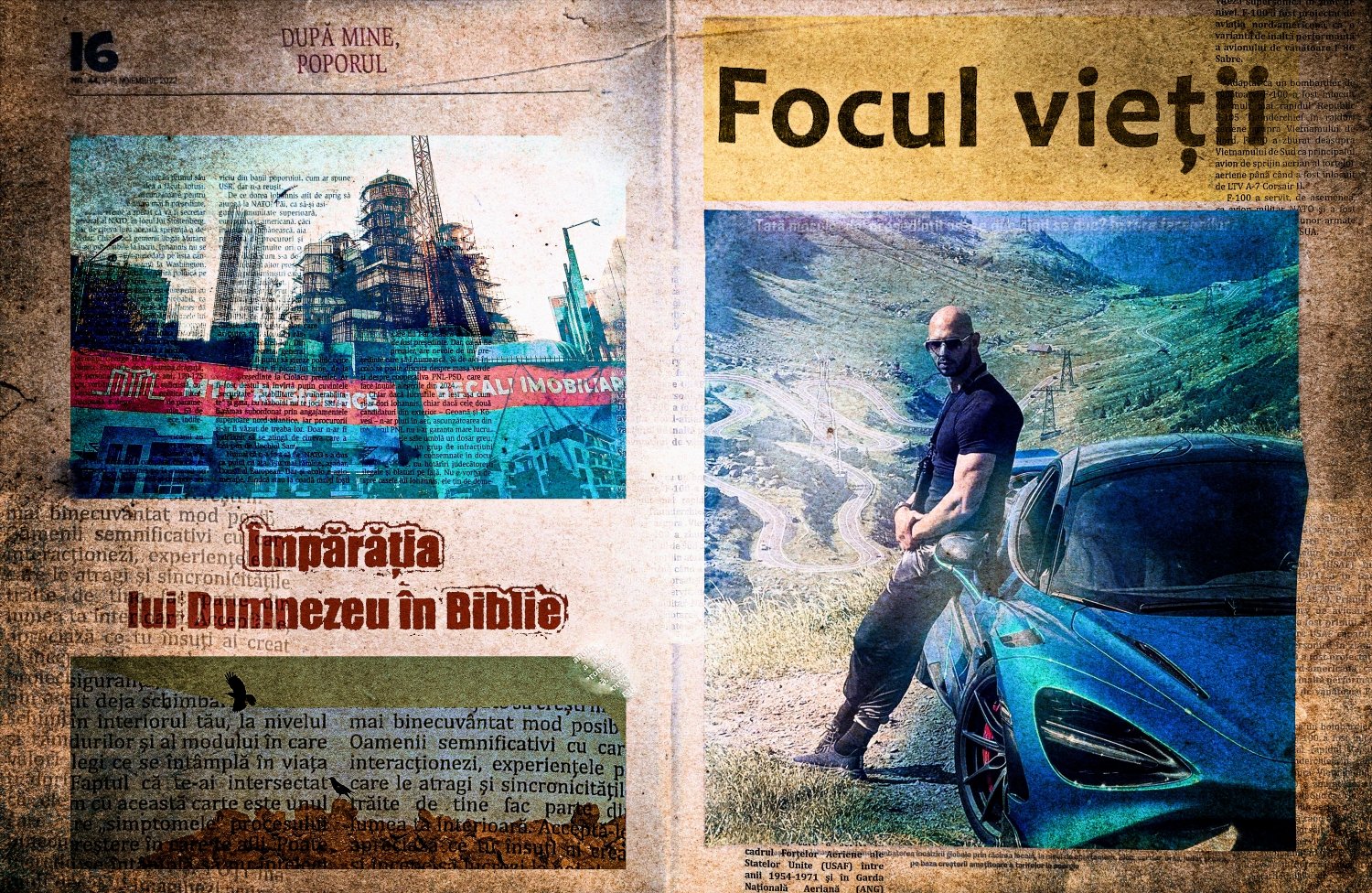
Cover details: Andrew Tate photo from Wallpapercave with Romanian Newspapers I bought and digitally tore up to combine.
The image with the birds and image with the church are mine (both taken in Pipera – Voluntari) © Alexandra Crisbășan
Andrew Tate stormed across everybody's screen. Through a meme, short clip, hate post, an interview or podcast, he was the most googled man in the world and this helped people form opinions within the extremes. The social media ban worked in his favor in terms of publicity and it’s not surprising why.
Who is Andrew Tate? Just a business man helping young guys “find their way” through Hustler University? A trafficker, an ex-champion who found ways to make money from online hysteria or simply a blunt misogynist who’s set fire to the polyester skirts of the woke culture?
Attention was brought upon Tate for instances where he seemed a threat to women, verbally or physically. He often defends himself by saying those were cuts from longer format content taken out of context or that the actions were consensual. Comments in which he seems to support corruption are famous as well.
Keeping in mind that everyone carries some dirt, I don’t believe in saints or sinners.
I think we live in a world full of Amber Heards in different forms, genders. Some are working in important companies & institutions; others are influential individuals or regulars.
Taking into account the persona Tate presents, his approach makes sense. What doesn't make sense is why everybody cares? We’re helping him right now.
Young people are impressionable and Tate can have a negative impact, but when will we be able to admit that we’re responsible for how our youth develops? Isn’t their impressionability linked to our terrible education system and our inadequate ways of helping them grow in harmony? Are we in a poorly made Hollywood movie where characters are either positive or negative, with nothing in-between? Is Andrew Tate a despicable man with an insidiously cleverly written script? Did he move to Romania because his vibe can attract the tribe for all to be well in gangster’s paradise? Is he another kind of 'con artist' who has found his niche? In our mindless pursuit of distractions, I think we’re choosing the easy way out – the way of predefined opinions.
When everybody jumps into anything without questioning, nuance is lost. The problem is we're running out of truths to make lies from. Everything we’ve accommodated to is standing on thin ice. This isn’t news; its history repeating and we’re always unprepared.
This article aims to explore the phenomenon of Andrew Tate and the online craze, while hoping to illuminate some points about society, from a “Romanian point of view”.
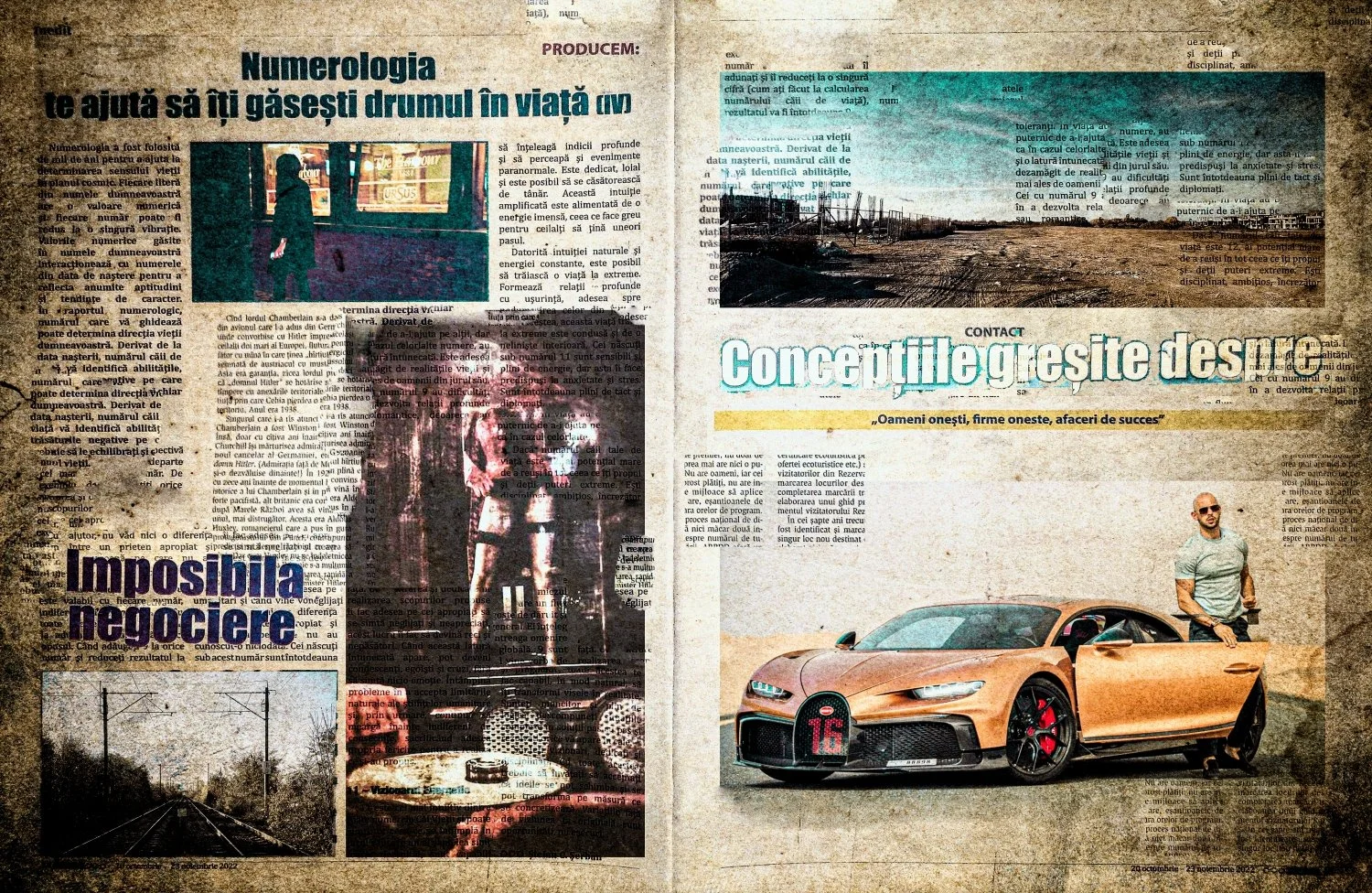
Collage details: Andrew Tate photo from Wallpapercave with Romanian Newspapers I bought and digitally tore up to combine. The 2 images with women (one taken in Piața Amzei and the other in the Old Town), image with field and image with train tracks (both from Pipera) - © Alexandra Crisbășan
Who is Andrew Tate and why
is everybody interested in him?
Born in Washington and raised in England, Andrew is the son of the chess player Emory Tate, who became an internet personality, as he also has controversial things to say.
Tate started as a professional kick boxer and continued with finding different ways to make money, either through a cam business, owning casinos or through memberships for Hustler University (teaches you to make money) and the War Room (members network). To form your own opinion, I’d recommend the interviews with Patrick Bet-David and Rob Moore. Below you’ll find a summary & analysis of his controversial declarations.
Andrew Tate, Women and Sexuality
He said we can’t drive and he demands absolute loyalty from “his woman”, while not necessarily having to provide his own share, because as per the will of God, men always had multiple wives. He doesn’t know how to healthily intertwine responsibility and authority, while having a rather possessive discourse and calls non virgin women “used goods”.
Religions and spiritual beliefs of any kind, whether they speak about relationships between women and men or not, shouldn’t be enforced upon the masses, ever. They still are.
If a man is happy with multiple women and multiple women can agree to share one man, where’s the problem? The way in which he demands loyalty is dramatic, authoritarian and toxic, but only women who’ve been with him should have the right to comment on how he behaves. I get why he is triggering, especially to those who faced abuse, but the labels we place influence too. We should step in to educate, to find a middle ground. This is the medium of information, not the court of law.
Robert, a journalist whom I interviewed for this project, gave me a reference from The Guardian, where Ruth Davison, CEO of the domestic abuse charity Refuge said, after stating why Tate’s influence can be dangerous, that:
“We’d love to see platforms do more [to tackle it] themselves but they’re not going to because they will lose competitive advantage [the Social Media companies], so it needs to be the government.” Robert also told me: “in terms of journalism, Andrew Tate should be handled as a subject as long as his decisions and his actions influence other people’s lives. […] and for the authorities, also.”
My point here is; we should be exclusively focused on providing useful, balanced information. That will help other competent parts of the system to do their job.
It’s painful to read that women who’ve had sex are labeled as “used goods”, but it does underline a point. Our relationships, sexual or not, change each of us. When we choose our partners, we take into account “if we can handle” whatever “scars” or habits the other has (and not only this), often in a less conscious way. The less conscious part can be translated in somebody interpreting this the way Andrew Tate did.
He also believes that women should bear responsibility if they are raped and have put themselves in that position. He says women have been exchanging sex for opportunity for a long time and not all of them are abused. He thinks sexual harassment is disgusting, while differentiating that: “A man looking at you or whistling at you or asking your name isn’t harassment.” He complained about how before his fame boomed, his first two girls worked for him because of love and that later on he started hiring girls who are in it for the money and exemplified how he would attack a woman if she accused him of cheating. Etc.
I don’t understand why having to be responsible for yourself is considered to be blaming the victim? Why don’t we, women, want to help men make this distinction, too? Claiming utopian rights when we’re closer to a dystopian edge is like trying to charge a car that runs only on gasoline. As a woman, I understand life isn’t and shouldn’t be risk-less. I always do what I can to defend myself. When it fails, it’s another part of life and as a victim, it is my responsibility to identify what I need to do, in order to heal. Until the whole planet will agree that we should not abuse each other, we have to learn how to take care of ourselves, especially if we have to or choose to take part in situations, we’re more vulnerable to. People have a right to live their lives as they wish and they will get hurt for it. It’s not okay, it’s reality. You have to own your wounds. Abusers rarely will and the system doesn’t provide a 100% success rate. You get help & lend a hand when you can.
The situation of women in society is too complicated for #metoo to do us justice or any other kind of movement, as long as there will be women who will use these manifests like Amber Heard did. I’m sick of these double standards and I’m not the only one. For example, it’s one thing to get your drink spiked. Deciding, sober, the next day, that you didn’t like the drunk one-night stand you wanted fully in that moment and that you should call it rape, is another:
“it doesn’t scream rape and it’s not something to dramatize, especially on the internet. I know a guy that's been through this exact same experience” responded Astrid “It caused him much hurt. People threatened him, said they will kill him or beat him for nothing. This is a very toxic thing as well. Not only males can be toxic, but generally, I think guys should be more understanding and women stand up for themselves more.” – continued Astrid.
Sex work is one of the oldest jobs in the world. While being a sex worker is often problematic, not only in Romania, I don’t think it can be 100% a valid argument because the situations are too varied. Clearly, not all women fit the profile of a helpless victim who must continuously battle patriarchy. There are women who choose to do sexual work and too many who don’t. There are also women who are part of industries that exploit women.
We’ve both contributed to the evolution of these sexes. Women are and were oppressed, have every right to stand for themselves, be protected and demand equity and equality. Unfortunately, I don’t understand this righteous attitude because of gender. We have a strong share of trauma, they do too. It is still partly our responsibility to help men evolve along with us, not just point out their faults. We are their grandmothers, mothers, sisters, wives, daughters, friends and coworkers. All of us are forced to be someone we’re not, to do things we don’t want to do. Why don’t we take responsibility as a whole? In the same way that parents should take care of their children together?
Sexual harassment and abuse are horrible and nobody else, but us, has taught us healthy boundaries and most of us were unqualified for it. I think that if I am walking on the street and a guy makes a comment, it’s a public place. People are free to say, think and do as they please until it’s certain they have crossed my boundaries.
Treating anyone like a sub-human because they cheated is something I don’t agree with. Moreover, to me, violence is the answer only as self-defense, when nothing else works and while you cannot expect people to act ideal in tense situations, you can teach yourself and help people around you to learn to react in proportion to what’s happening.
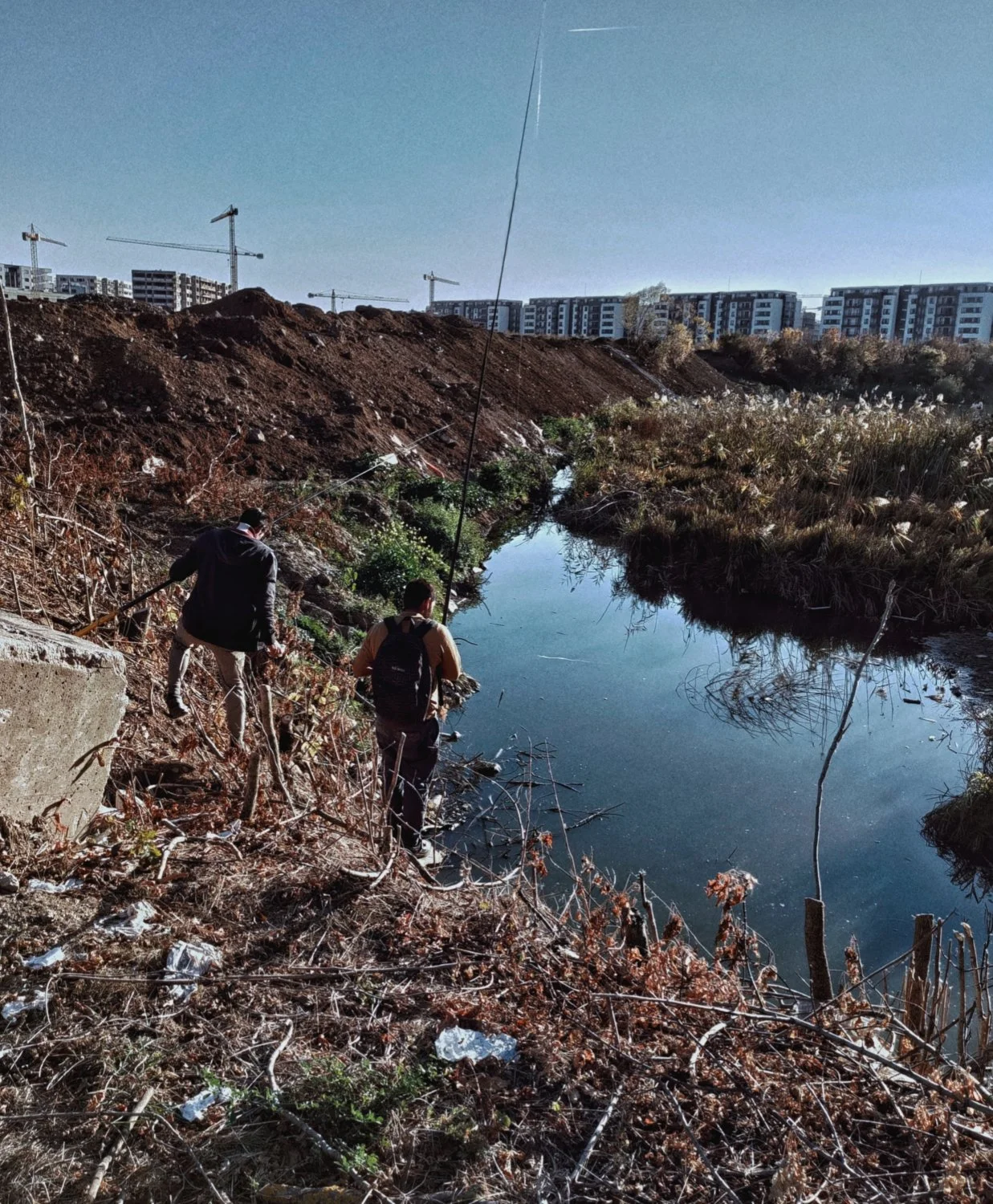
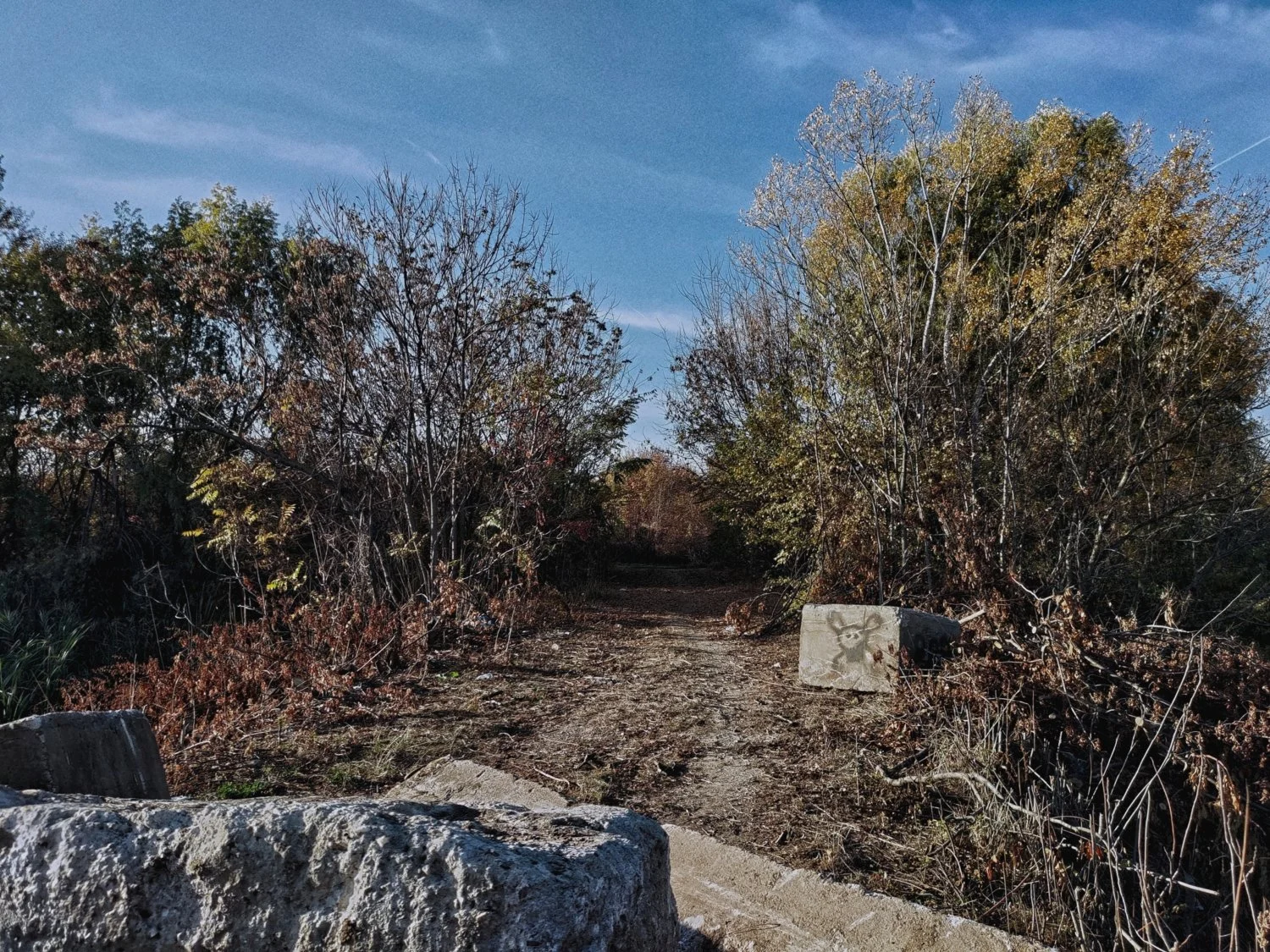
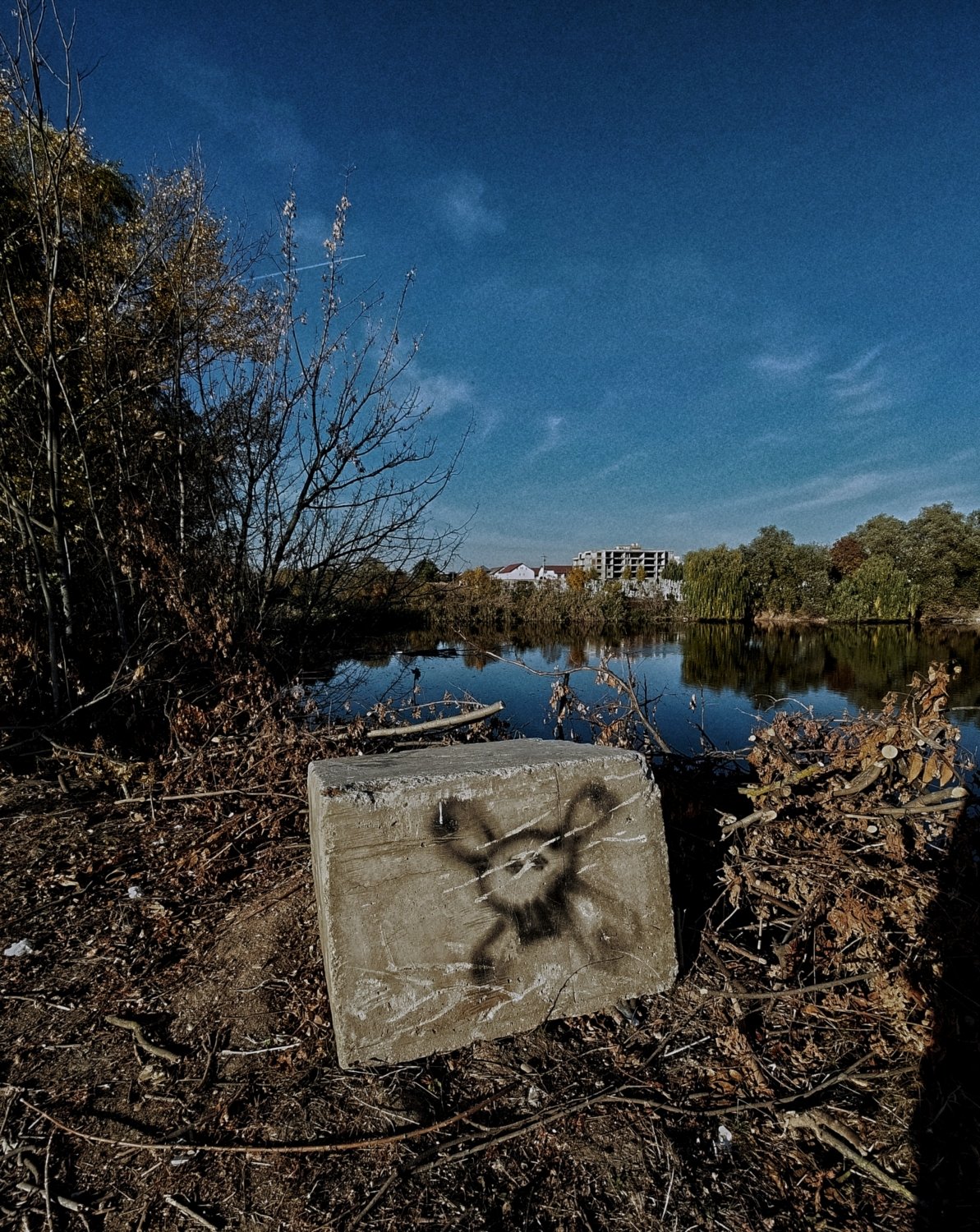
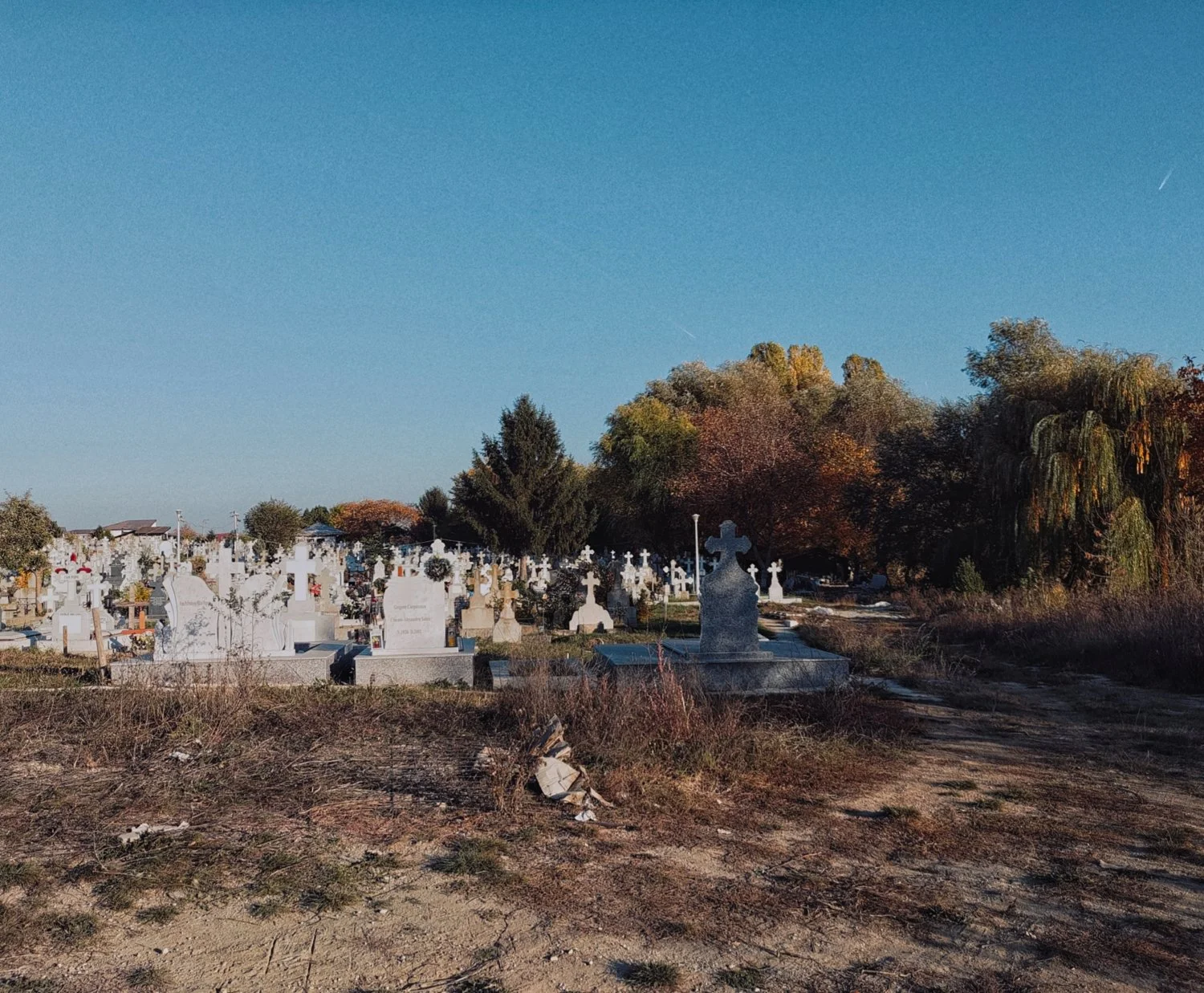
Photos details: © Alexandra Crisbășan, images captured on the way to Andrew Tate’s neighborhood. The two random men went out fishing.Depression isn’t real and successful men
There are multiple instances where Tate said depression isn’t real or sad people should just get up and change their lives. He thinks that because circumstances influence our depressive moods, that’s why we should focus on change instead of believing in depression. He blames people for using this disease as an excuse to not better themselves, adding that those prescribed anti-depressants should have a better diet, a life purpose and exercise. Well, he is not a psychiatrist or a psychologist in order to grasp the human mind in a profound way. This is a mantra of resistance which gets him through the bitter parts of life, a coping mechanism. Not a terrible one, it just shouldn’t exclude depression.
There are two sides to the coin and they should meet in the middle. As a default, life is a struggle no matter how privileged you are. On the other hand, we have the domain responsible with treating mental issues. Like life, this domain isn’t flawless. It can be difficult to afford and to find somebody who can help. It is true that to overcome mental problems you need to gather the internal strength to take action and change your life and yourself, but what Andrew Tate can’t see or doesn’t want to see is that even if he’s had a tough upbringing and succeeded, even if there are many people who do, some of them find themselves unable.
It doesn’t matter how “capable” a person appears on the surface. The capacity to get over your issues has nothing to do your skills or who you are. There are tons of heartbreaking cases where efforts came to nothing. If you can soothe cancer patients in terminal stages, you should be able to soothe, without judgement, somebody who simply is “terminal” mental wise. If some use the mental health card to avoid responsibility, whether that’s true or not is irrelevant.
If it is true, you wouldn’t want somebody who doesn’t take responsibility; they wouldn’t be trustworthy. If they can’t, you can’t consider them. People who are made to be able to change their circumstances no matter what, will.
By the way, Andrew Tate believes there are some “core things” which make a man successful: the first one is earning more money than a “slave” job can earn you. The second one - to be free enough to do anything you like. The third one - to form a network of people with powerful, influential drive. The fourth one is having an adequate body language and being able to impose your presence. The last one is having many women adore you because “women are the ultimate status symbol.”
We know that a regular job, while it can bring you a satisfactory life, if your aim is to earn more money than you will ever need, it’s not going to happen. A regular job takes up too much of life. On top of that, Romanians for example, generally have terrible salaries and the system takes more than 40% of our income. Of course, people will want to find ways to cheat this! I think Andrew Tate is mainly right about networking. However, only in the sense that you should want to surround yourself with people who help bring out the best in you and you the best in them.
The imposing presence and females as the ultimate status symbol contradict each other. I'd think that if I'm that "badass" as a man, my own worth is my ultimate status symbol. From an evolutionary point of view, because humans are animals, I understand why women are viewed as the ultimate status symbol. Women give life. It’s the whole mating thing. Just because humans can have sex for pleasure and the intellect to go over evolutionary triggers, it doesn’t mean they don’t exist. The problem, yet again, stems from lack of education and a lack of knowledge of self. How many kids are taught how to form healthy relationships?
His views on men work on young Romanian guys because we are known to come from broken homes. The most stereotypical Romanian family has at least one parent who: moved from where they were born, to have opportunities, works a low-income job, is religious, has an addiction (often alcoholism) or unhealthy habit and is abusive or unfit to parent. This stereotypical family has at least one child and might live with other older relatives which, may possess the unhealthy patterns the parent/s do, if they don’t or along with them. There are many kids in Romania that cannot look up to an adult during their formative years. When somebody like Andrew Tate steps in and he’s also had a tough background, for these kids it’s easy to see him as a role model. Those problems cannot be solved by motivational speakers. They are hard to mend even for doctors. It’s easier to cling onto false leading hope, because the “antidote”, the solving, the “illumination”, is a goal for the later future, not today. Today, each of us regardless of what we believe, wants to feel like we are living too, not only surviving.
Adrian had an interesting response when I asked him if Tate should be famous or not and what does his fame say about general education in Romania:
“I don’t think the question should be this one. The phenomenon of him getting famous was inevitable. The question is how we, as a society should manage this kind of phenomena. Yes, I think the education system is failing most of the young people. Families do their best but often their knowledge and means are limited in a developing country. In the last decades, the means of communication and information propagation fundamentally changed. From books, written media, radio and TV, we shifted almost entirely to the internet. This is a blessing and a curse at the same time. It changed the dynamics of society itself. Knowledge is power. Information is power. Controlling information is even more powerful. When I was in middle school, if I wanted to find out more about a subject, I would have asked my parents, teachers, relatives, friends or go to the library and get some books on the subject (if there were any). Now I take the phone out of my pocket and in 10 minutes I have everything I need. Everything is faster now and unfortunately the division is based on ideology also. We are the victims of our own evolution and creation.”
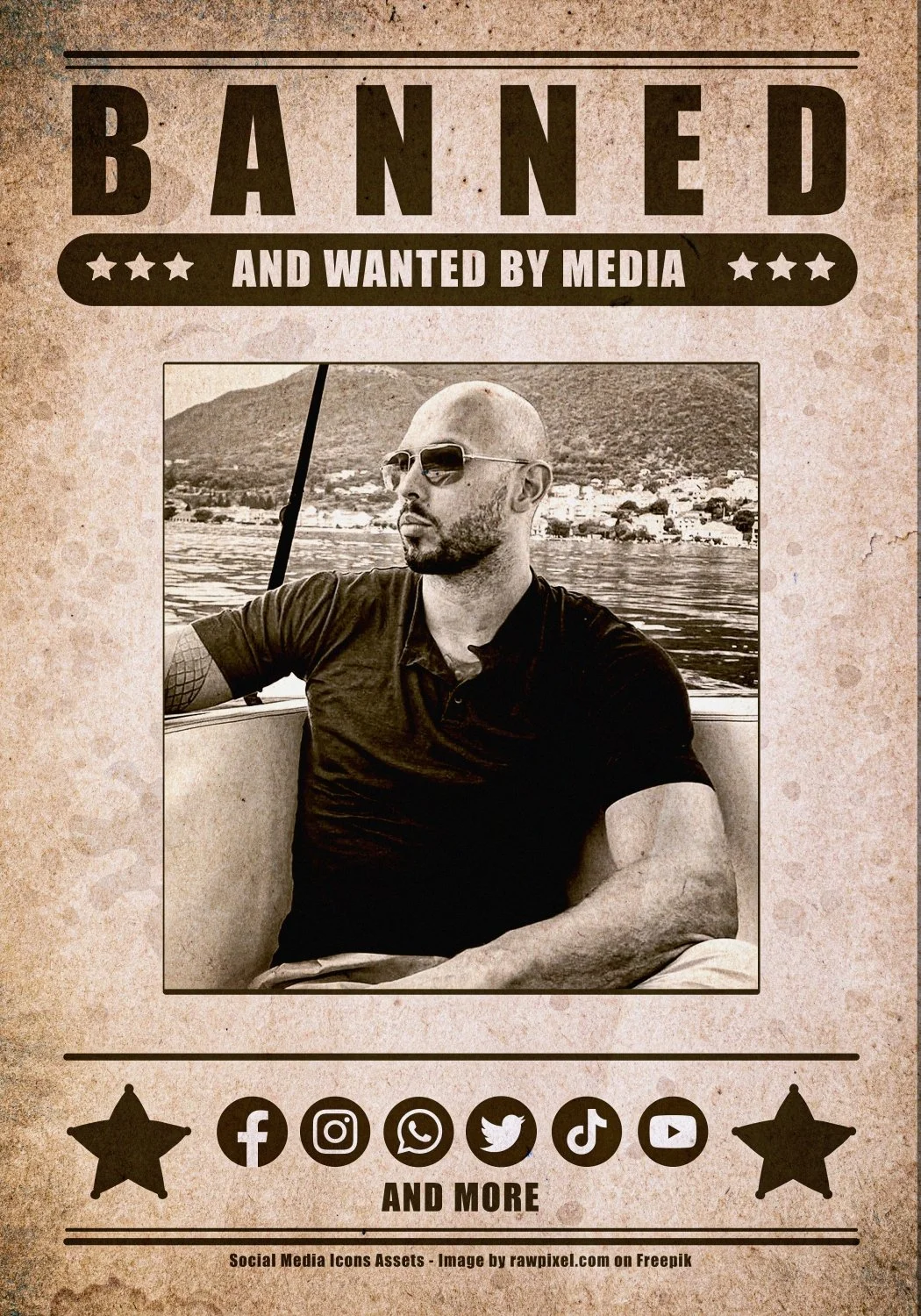
Poster details: Andrew Tate photo from Wallpapercave, social icons from <a href="https://www.freepik.com/free-vector/social-media-icons-vector-set-with-facebook-instagram-twitter-tiktok-youtube-logos_17221200.htm#query=social%20media%20icons&position=0&from_view=keyword">Image by rawpixel.com</a> on Freepik & poster template shutterstock
The social media ban
Because of his extreme persona, Andrew Tate mentioned in an interview that he was banned on more apps than just social media and this is wrong. I believe media corporations are more harmful than Andrew. They make billions from our data and their “community standards” are absolute bullshit. I’m saying this as somebody who’s been banned on Facebook before and suffered other minor sanctions on it and Instagram. I don’t make videos or content where I force my views on people, but I do promote unconventional art. I find it stupid that we are offended by the human body, especially when we’re not talking about porn, we’re talking about creation. I think today’s censorship is a perverted connoisseur. We can be easily fooled that we are not censored and that it’s just common sense.
Having gore groups, animal cruelty and content promoting self-harm, while not being able to view a beautiful topless woman is not common sense. Neither are people being banned for saying what they believe. Sure, I agree that extreme views should be less visible (keep them in their niche), but nobody should enforce an internet mentality as law. Teach harm reduction instead!
I’m not supporting Andrew Tate for what he does and I do not follow his views or want to encourage others to. Everyone should learn to think for themselves. It is impossible to make social media and the internet a safe place for everyone and it shouldn’t be like a sterile hospital room because that restrains freedom. Maybe it would be more beneficial to live in a society where people ease into the use of the online world with knowledge, curiosity and caution, instead of cult-like believing in illusions. There is no bigger force than the accumulated energy of collective effort. The problem is people who think a nipple is offensive, discovered it first.
When asked about censorship, Adrian said: “In principle I am against censorship. You cannot fight contrary ideas by pretending they don’t exist or worse, by trying to forcibly silence them. This only deepens the division and creates opposite reaction. A distinction must be made between freedom of speech and saying whatever you want. Even though they might seem the same they are not. Freedom of speech is not absolute and it is mainly limited by other rights. Media companies have a social responsibility also given their substantial power. Let’s take a simpler example: fake news. Some people might argue that it is free speech and that everyone is responsible for what they believe, but I disagree. It is a dangerous phenomenon that can create social unrest, can manipulate the markets and can polarize people.
Can everything be considered free speech? Can you simply fight it with more truth? We’re still figuring out the proper way of preserving freedom of speech (assuming that’s what we want). I'm not sure if, in this case, banning Andrew Tate from media platforms would benefit the cause of fighting him, but then again, we're dealing with a complicated scenario where companies have financial and ideological interests.
[Comparing online censorship with the one Romania faced during Communism] I couldn't say that anyone had more freedom of speech during that time. The limits were way clearer (and narrower) and the consequences more palpable, which can leave the impression of a finite and limited censorship. Nonetheless, nowadays in Romania you can say pretty much say whatever you think without the fear of going to jail. You might be banned from a social platform, but it’s difficult to compare. And then there’s public opinion that you have to face, but that’s also everyone else’s freedom of speech. Companies that do not wish to do business with you have the freedom to choose whom to do business with. I will say this again: I don’t think we must fight people, but ideas.”
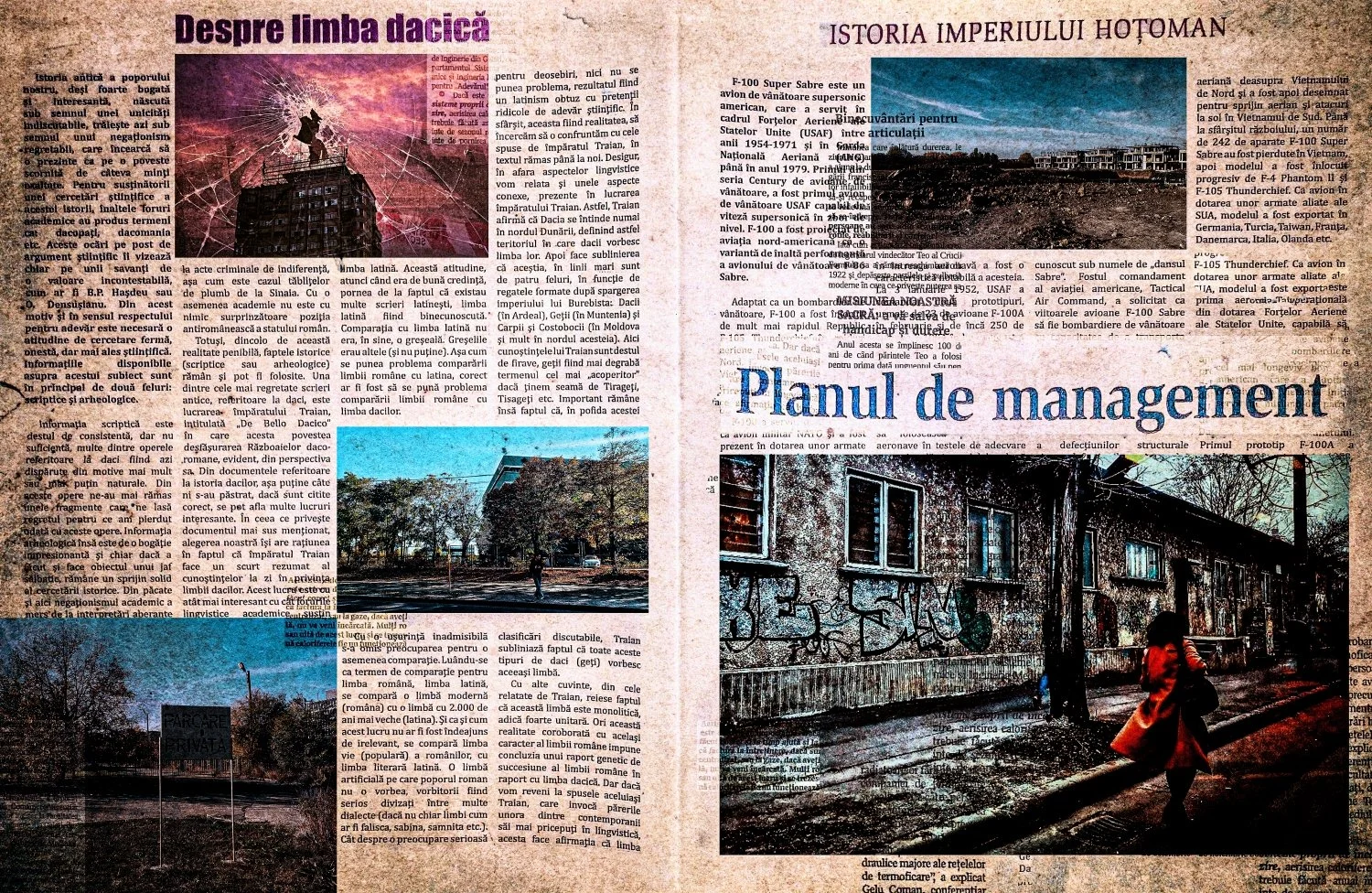
Collage details: Romanian Newspapers I bought and digitally tore up to combine. The images 1. Somewhere in Sector 1, 2. Bewtween Pipera & Voluntari, 3&4 Pipera, and 5 is a picture taken somewhere in Sector 5 © Alexandra Crisbășan
What about Andrew Tate and Romania?
People know that Tate chose Romania because he likes to be free to do what he wants, because corruption is more accessible, because he is angered by the way in which the western world operates and: “If you’re a man living in England or Germany or America or any of the western world right now you’ve decided to live in a country where any woman… at any point in the future can destroy your life.“
Before I begin to talk about corruption, I’ve heard Tate moved to Romania to also escape UK charges. Except for a raid on his house in Romania, where nothing was found, nobody has said what happened to those charges. For this reason, I have tried to find some law websites from both Romania and the United Kingdom to find out whether there are active cases his name, related to sexual abuse. I’ve found none.
The fact that nobody is doing a follow up on Tate’s legal issues is something to keep in mind. In Romania, bribes take you a long way, if you have enough money and know how to play. If you’re like him, Romania will be a breeze. If you’re a regular person though, you will find out that Romania doesn’t really know how to do things for its inhabitants.
The poorer they are, the less they are helped, unless they choose to take, at least a little bit, part in the corruption game. Things shouldn’t be as radical in the way of righteousness as in the west, but neither as they are here. We’re too concerned over a dictatorial morality, because an inner sense of humanity, but people will always scam and do their best to get their way around. It’s not about stopping the cheaters forever; it’s about doing your thing useful enough that cheaters won’t matter. We need patience and an understanding of our current actions’ impact in the future.
“There’s nothing to blame him for wanting the easy way or the right way. But if corruption is what’s appealing about Romania, it should leave us thinking. Romania has the advantage as much as the risk of being in a developing state, leaving open the opportunity of growing a lot. The question is how will it mature? In which direction, towards what values? Can we learn from other’s trajectory, do we even have the power and will to make our own? I sure hope so. I don’t think corruption has much to do with what defines us as Romanians. Despite that, anyone can argue that corruption is not in line at all with religious beliefs in general and Christian ones in this case. Yet, we’re one of the most religious countries in Europe and one of the most corrupt. How we got here is a subject for a complex analysis, but the core cause is poverty and dictatorship. We’re still learning democracy and wanting to be part of a family (UE) partly forces us to change. I think we need a critical mass to reach a significant change by means of representative democracy. It’s sad to say this, but probably the elected are a mirror of the electorate. We are too poor to not invest in education. But somehow, we don't seem to be able or to care about it very much.” – said Adrian.
If you’re wondering where Andrew Tate is in Romania, well, he’s right in the capital, Bucharest. Living at the edge of the city, in one of the neighborhoods frequently picked by rich people, Voluntari. In that fancy neighborhood, there’s kind of a street that has many properties he either owns or has something to do with (which is why I could only capture only the very beginning of that street).
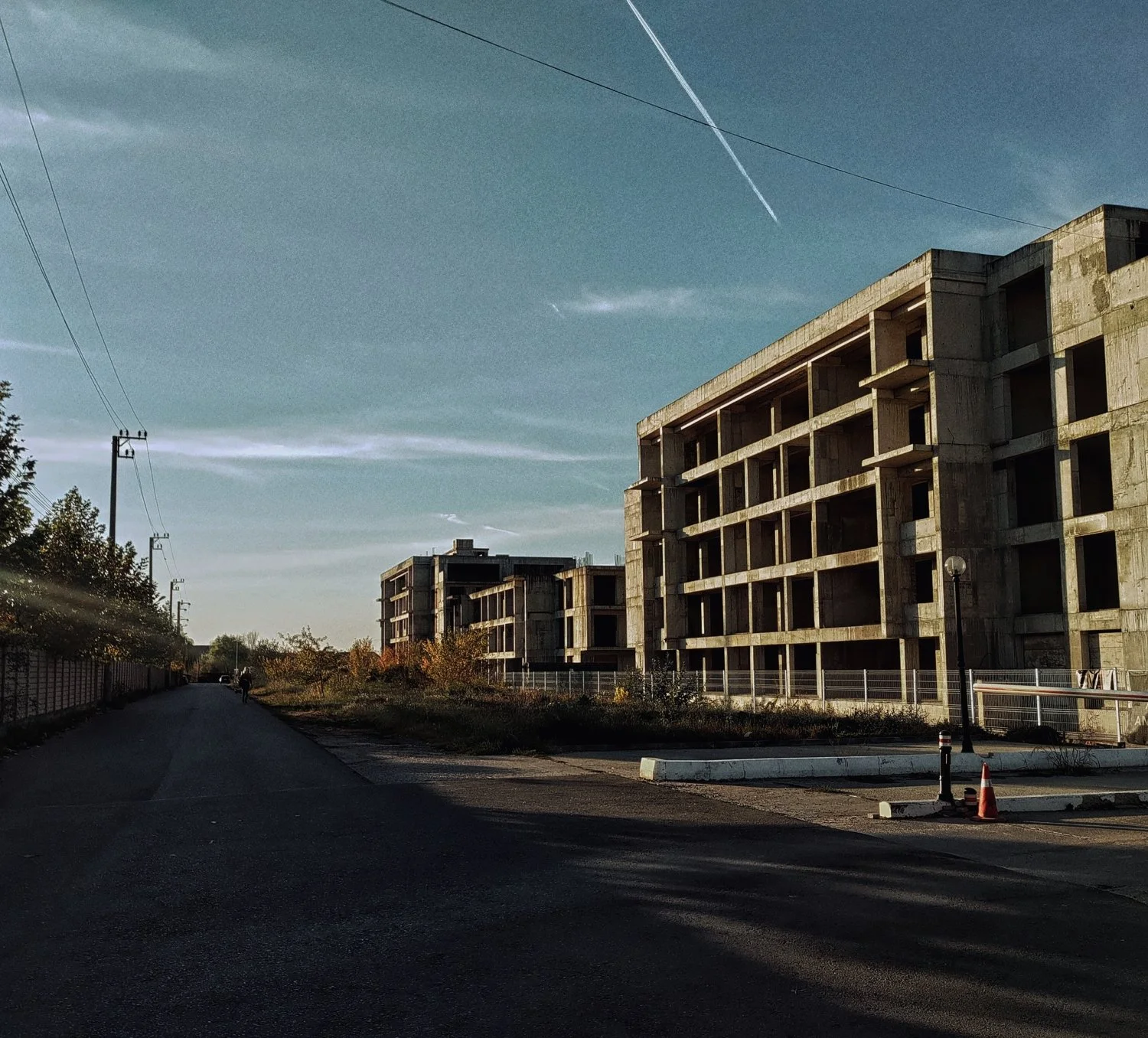
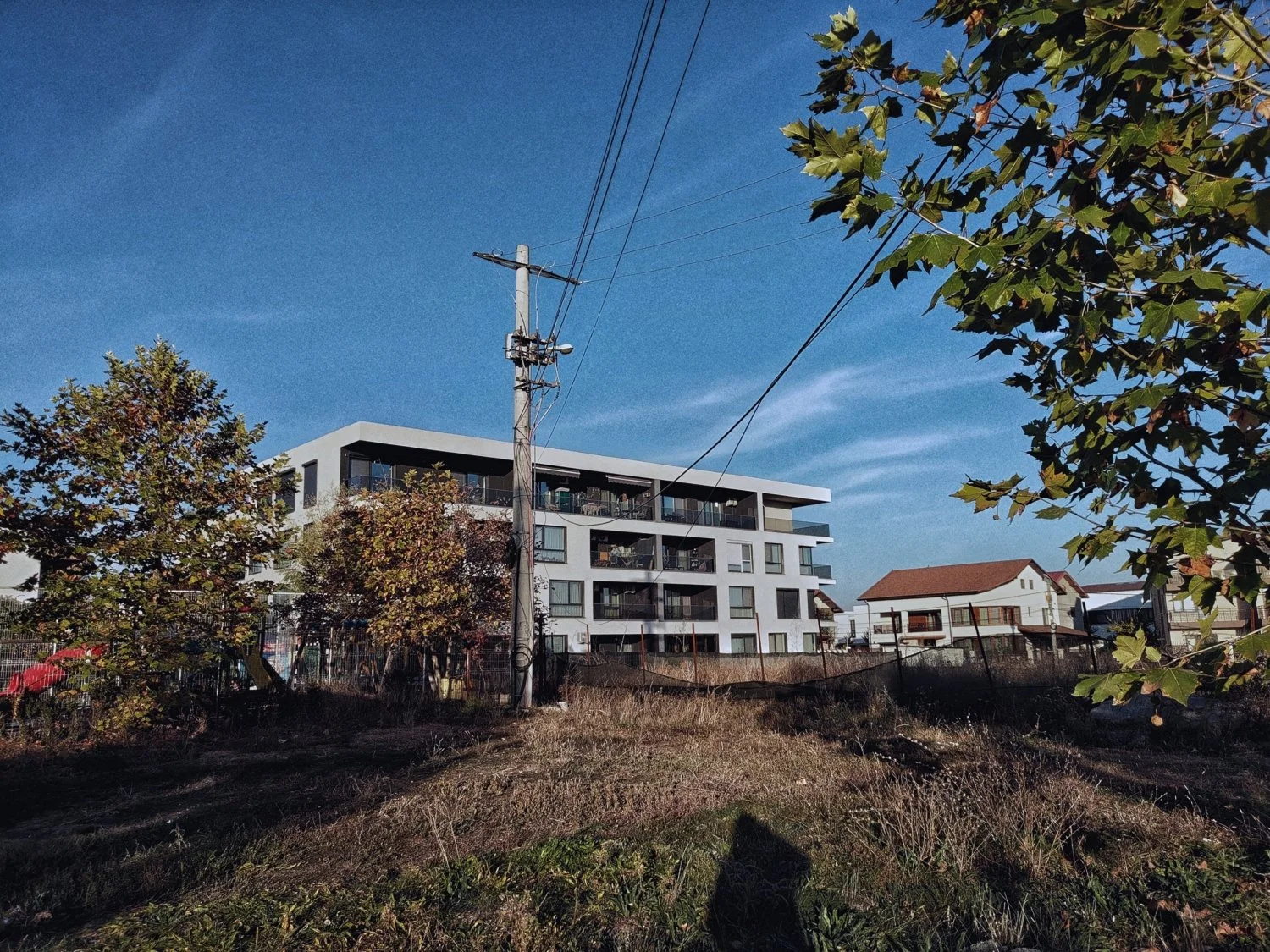
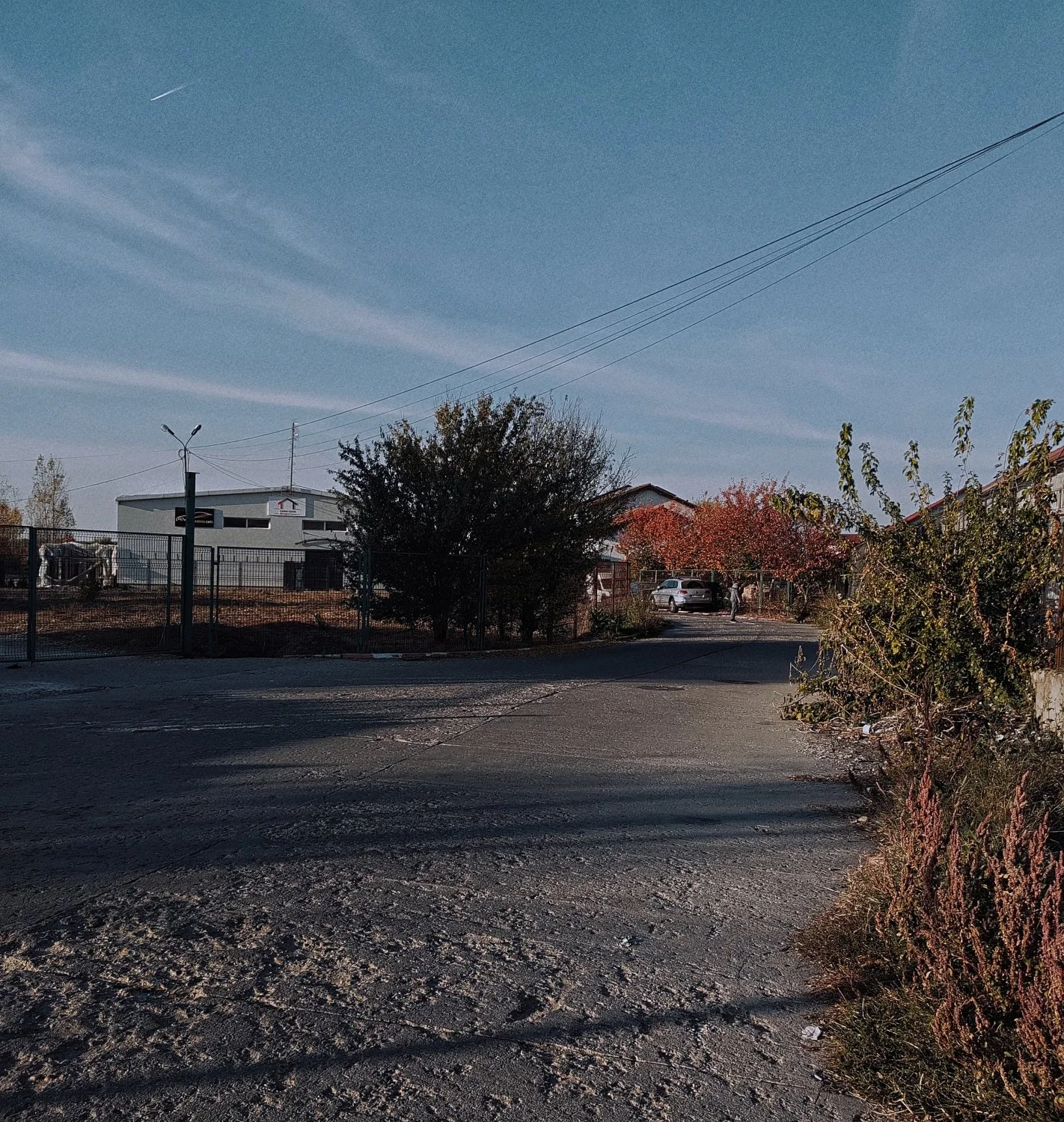
Photos details details: Andrew Tate’s street photo 1 & Neighborhood 2 & 3 © Alexandra CrisbășanWhen I went to actually see where he lives, I was encountered by 3 fan boys who were waiting for his return and said that “they are too rich” for the guard to let them in. None of those fan boys were Romanians. My guess is that he’s building a “complex of cocoons” where he can have enough space to manifest and help his followers. However, I’m sure Tate doesn’t spend time only home. If he’s not in another city or country being busy, he might have visited the most “exquisite areas in Bucharest” apart from the popular ones, like the Old Town? Kiseleff, Aviatorilor, Cotroceni (more so in olden day though), Aviației, Pipera, part of Băneasa, Floreasca, Primăverii, Dorobanți and Sector 1 in general (in decline, however) are key ‘hoods. You can find some big money close to all outskirts of Bucharest too. Those are the places where you get that beautiful contrast of: here is a palace, next to it is a ghetto.
On his recognition factor, I’d say he is recognizable by his target audience, but I don’t think he hangs out in places where his target audience does, usually. It would be a conveniently calculated move, because he’d afford a degree of detachment and "invisibility" when he needs to be serious, while having his spotlight too.
Astrid is from the younger audience, so of course she knew about him:
“I am pretty familiar with Andrew Tate, considering how much he was posted and commented by everyone on social media. […] The phenomenon was overly dramatized, as a normal reaction to controversy; people felt the need to say something. […] he is definitely someone with mental health issues and has projected them through this. Being controlling and ‘above’ women made him feel stronger and even if the things are true or lies, his mentality shows it either way and it’s toxic. I don’t think he’s a real misogynist devil; this is the persona he created because of some insecurities or missing things from his childhood. He saw that this helps him grow and just went with it. […] His fame is making especially young boys and teenagers who watch him think that this is cool, this is how you should act and treat a woman and it’s very misconducting because it’s wrong. […] Most teenagers forget to be themselves and Andrew Tate is definitely not the one to take as a mentor. […] The social media ban was weird in my opinion and contradicts the free speech concept. “
Adrian for example didn’t know much about Andrew Tate until 2 months ago:
“His name popped up on different social media posts that I passed over, not knowing the context. Once it got me curious enough I “googled” him. I won’t lie, I didn’t take long to know I don’t like him. He seems like the kind of guy who likes to shock and provoke outrage and maybe this wasn’t a very sustainable path.”
Robert is another example like this:
“until this interview, I had no interest in who Andrew Tate is. How come? I did not have to deal with ‘the subject’. It’s likely that I’ve read in front of the camera a couple of news about his time in Romania, but this did not make me curious, so I googled. I remembered the subject ‘The two Britons accused of forcibly holding a young American woman in Voluntari have been released’. I’ve also read that ‘TikTok is failing to crack down on accounts that post misogynistic content featuring the banned influencer Andrew Tate, despite a previous pledge to do so, according to new research: ‘Analysis by the Center for Countering Digital Hate (CCDH) identified more than 100 accounts that frequently promote content featuring Tate, with a total of 250m video views and 5.7 million followers. Going further, I discovered an article by Jonny Walfisz (freelance writer for Euronews culture): ‘Tate’s content is defined by its violent vitriol, degradation of women and consumerist decadence. It’s a smorgasbord of the worst influences you could expect for teenage boys and younger. Tate has since been banned from Facebook, Instagram and YouTube’, plus ‘A UK study found 87 per cent of 12 to 15-year-olds use social media. Social media has become an aspiration […] a 2019 survey found British kids would rather become an influencer than an astronaut.’”
Obviously, people’s reaction depends on their opinions. Evidently there is a percentage of young guys who tend to be supportive, while their girlfriends or women in general tend to not like him. That doesn’t mean this is a black and white statistic.
I’d like to leave you another of Adrian’s insightful responses:
“The way he tries to downplay his own saying looks childish to me and it seems he’s not willing to take responsibility. You can’t be blunt and expect people to perceive nuances that aren’t there. I understand he’s fighting against some of the political correctness and woke culture ideas, but going to extremes isn’t going to reach the middle ground where ideas can meet. I don’t even think this was his goal – some ideological battle. I think he defined these aspirations himself quite clearly somewhere around having money and fame. After all, he was just expressing ideas and portraying his life philosophy. But when you stir the public opinion, you can expect backlash. It’s hard to believe that he was not aware of how what he’s saying is perceived and I think this is exactly why he headed down that path. The problem is that there’s a huge public for this kind of discourse. I think contesting ideas without bringing them in the spotlight is inevitable. Even if not giving attention to this phenomenon, I don’t think it would have been better. Things must be called out, but not censored or cancelled. In this social media world, we talk about players that are companies and they play a double role. One as a commercial company that has a goal for profit and another as a platform for speech. As private companies they can make their own […], but as a platform for speech people expect the same rules as in an ideal society: free speech and probably responsibility at the same time. I don’t know what Andrew Tate really is like. I only know the person he’s portraying to be and that person is toxic. If it’s a facade for media traction and notoriety its quite irrelevant. I think what’s to blame are the ideas and not the person.”
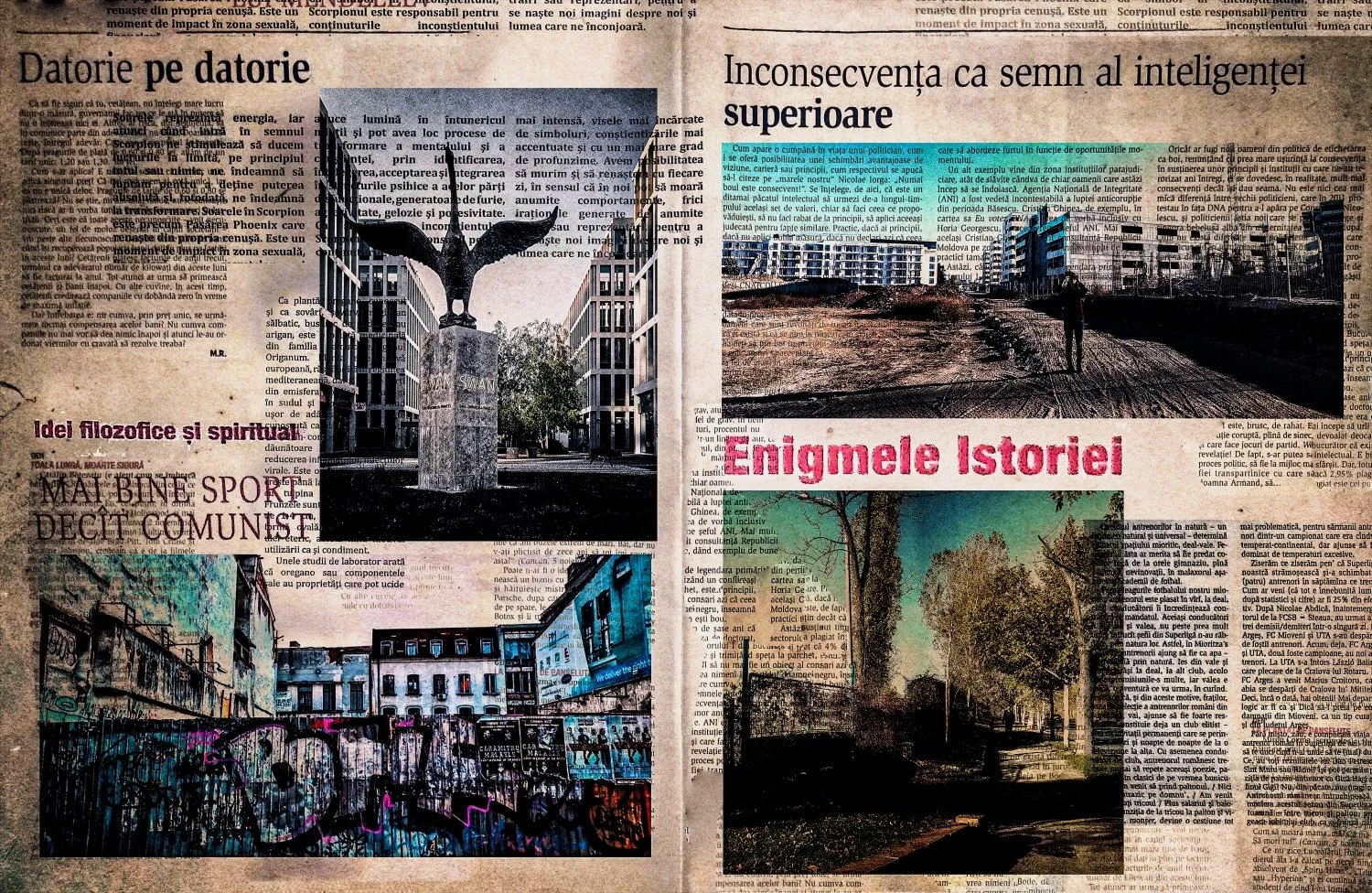
Collage details: Romanian Newspapers I bought and digitally tore up to combine. The images 1 – Pipera, 2 – Between Pipera & Voluntari, I think, 3 – Old Town Bucharest, 4 - Pipera © Alexandra Crisbășan
Romanian Stories and Perspectives
I’ve picked Astrid as a representative for the young generation, Adrian for his understanding of the human mind, since he’s a psychiatrist and Robert for his knowledge of what’s going on in the world, since he’s a journalist (his real name is not disclosed, otherwise he wouldn’t have been able to collaborate with me).
Astrid has 19k Instagram followers and, in that sense, I think she can “vouch” for them in a way. I believe she is an accurate representation of how young people are in Romania today. Unlike other youngsters with a strong online presence, she doesn’t integrate or activate on only one specific niche. To me she is the middle ground between “good kids” and the “cocky bastards” or extremists and while both ends of the spectrum might not relate her vision totally, I think there certainly are points with which all can relate.
She graduated the Arts High School in Bucharest and is right now studying Law. She is 21. Her goal is to become a makeup artist, model and even an influencer and she is not wasting time when it comes to pursuing her passions. Astrid gained her online followers from participating in projects related to her passions, appearances in music videos and collaborations with influencers. Slowly she’s built a community on TikTok, composed mostly of girls who like what she does and support her in staying genuine.
When asked about her teenage years and the view she has on Romanian adults, young people and generally living here, her response was:
“I was a very free teen, I had the opportunities to do almost everything I wanted and I have a family who did not restrict me from being my true self. These are not privileges many have. The anxiety and depression in teens are increasing considerably because they try to be very free like teens appear in other countries, especially America. They see on TikTok and socials other ways of thinking and being, but the adult parents in Romania are still stuck in the old ways and have faulty reactions that can traumatize their children. Nothing is perfect and this happens in other countries too, so, the main thing with Romania is: older people have no faith in youth, they don’t trust that we can maybe do things better. Personally, I think they, we, can!
Lastly, I like living in Romania. We have a unique way of being. You always have some place to visit or to have fun. You can discover traditions and subcultures divided by towns or in Bucharest, by sectors [we have 6 sectors, each with its own distinct history]. Romanians should focus more on spirituality [instead of religion] and evolving - letting go of the harsh past and mindset. Some changes I’ve seen lately give me more hope when it comes to how women and teenagers are treated and I am proud for that.”
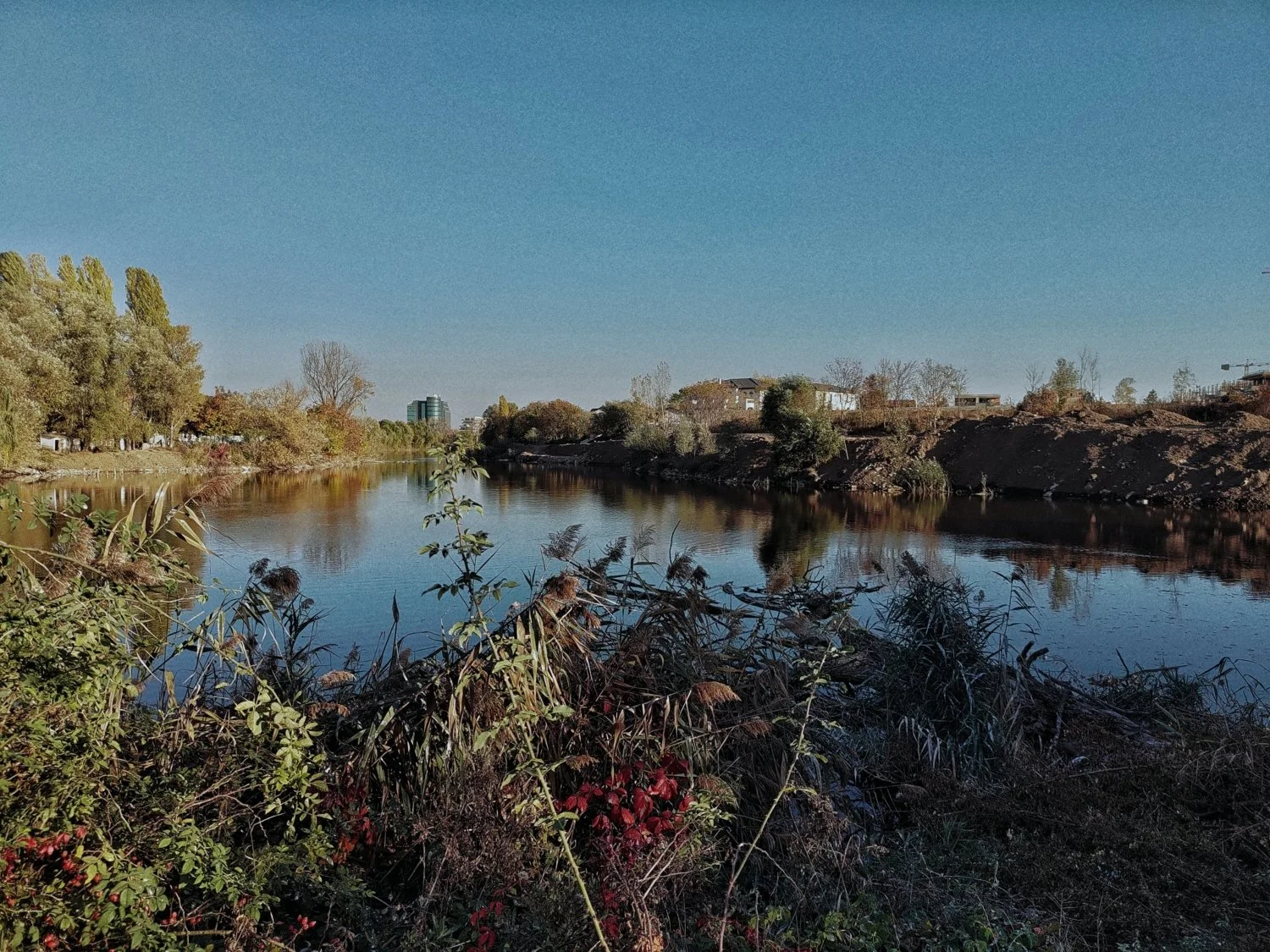
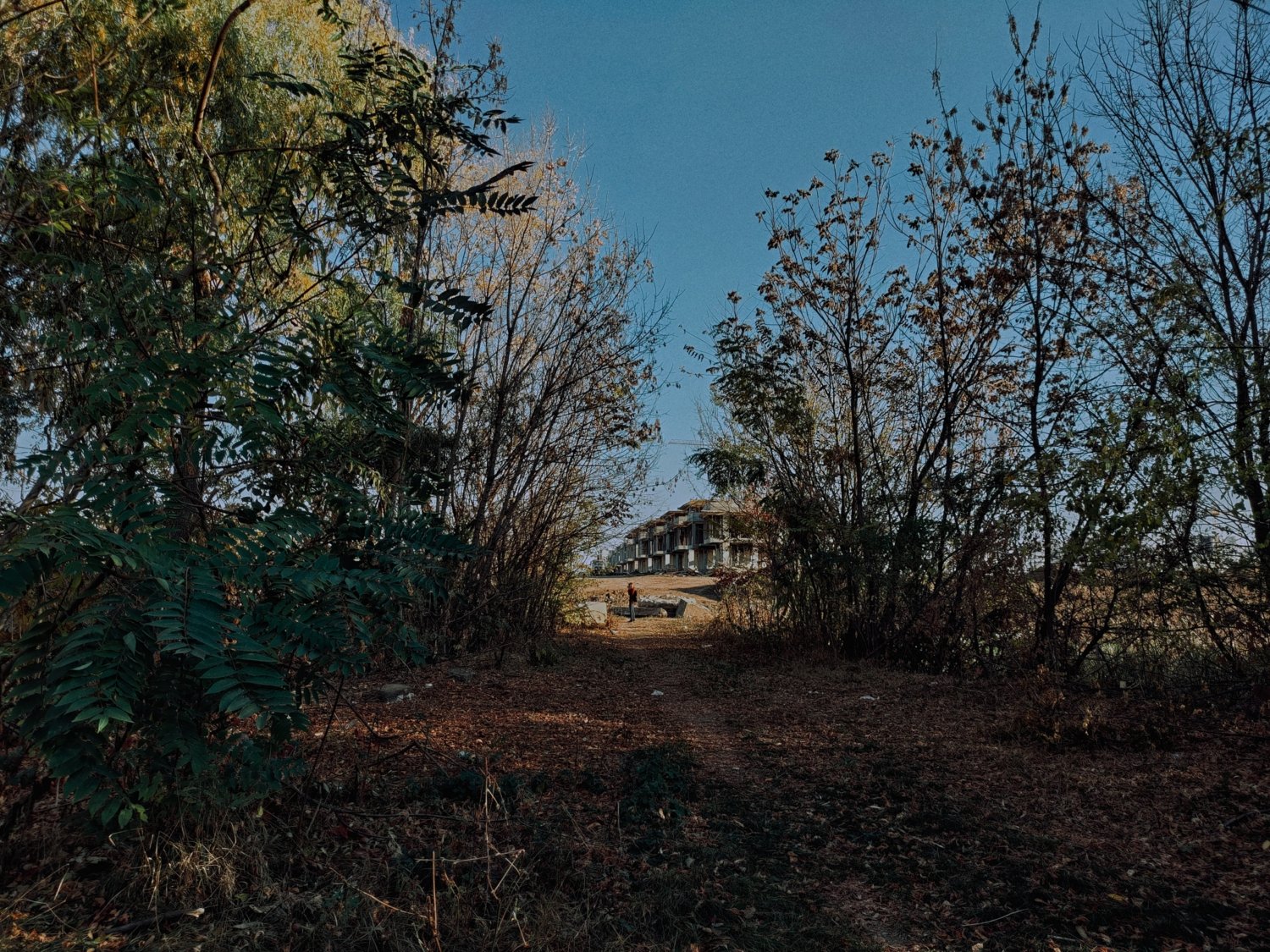
Photos details: Lake Pipera – 1, Captured on the way to Andrew Tate’s neighborhood - 2 © Alexandra CrisbășanAdrian studied medicine in Iași at Grigore T. Popa University of Medicine and Pharmacy, then did a year of training in psychiatry in the same city, after which he decided to move to Bucharest and finish his training here. After that he started collaborating with Aliat Clinic (a psychiatry and psychotherapy clinic specialized in addiction treatment), where he still practices today, almost 6 years later. He also works in a psychiatry hospital 2 days per month, doing on call duty.
“I’ve always been fascinated by the human mind and it feels like there is so much to discover in the field of neuroscience. Compared to our understanding of the universe for example, our understanding of the brain and the mind feels like the stone age. I didn’t know from way before that I wanted to become a doctor or a psychiatrist. The desire to help people directly and my curiosity for the mind slowly led me this way. Practicing as a psychiatrist helped me become more compassionate and working in addiction made me less judging and understanding. I am one of the lucky people that love what they do for a living.
Besides work, I love spending time with my friends, few things beat human interaction; I’m interested in science and reading about medicine, biology, technology, cosmology, but I’m also an art consumer. My mind and soul are hungry alike.
[About Romania] I think that because we went through some rough times, we understood the value of helping another. It’s still fresh in our memory, because poverty is still palpable a few kilometers away from the big cities or in some neighborhoods. We can’t be blindsided by the mirage of capitalism in its fiercest form. We were taught to manage with what we have and it made us more creative and resourceful. I find rural residents, most of them elderly, to be some of the most warmhearted and kindest people I know. It wasn’t easy growing up in Romania, but I wouldn’t change a thing because we are who we are, the culmination of our experiences. While being underdeveloped compared to the western world, it has much more space to grow and therefore, great potential. For me, Romania is home.”
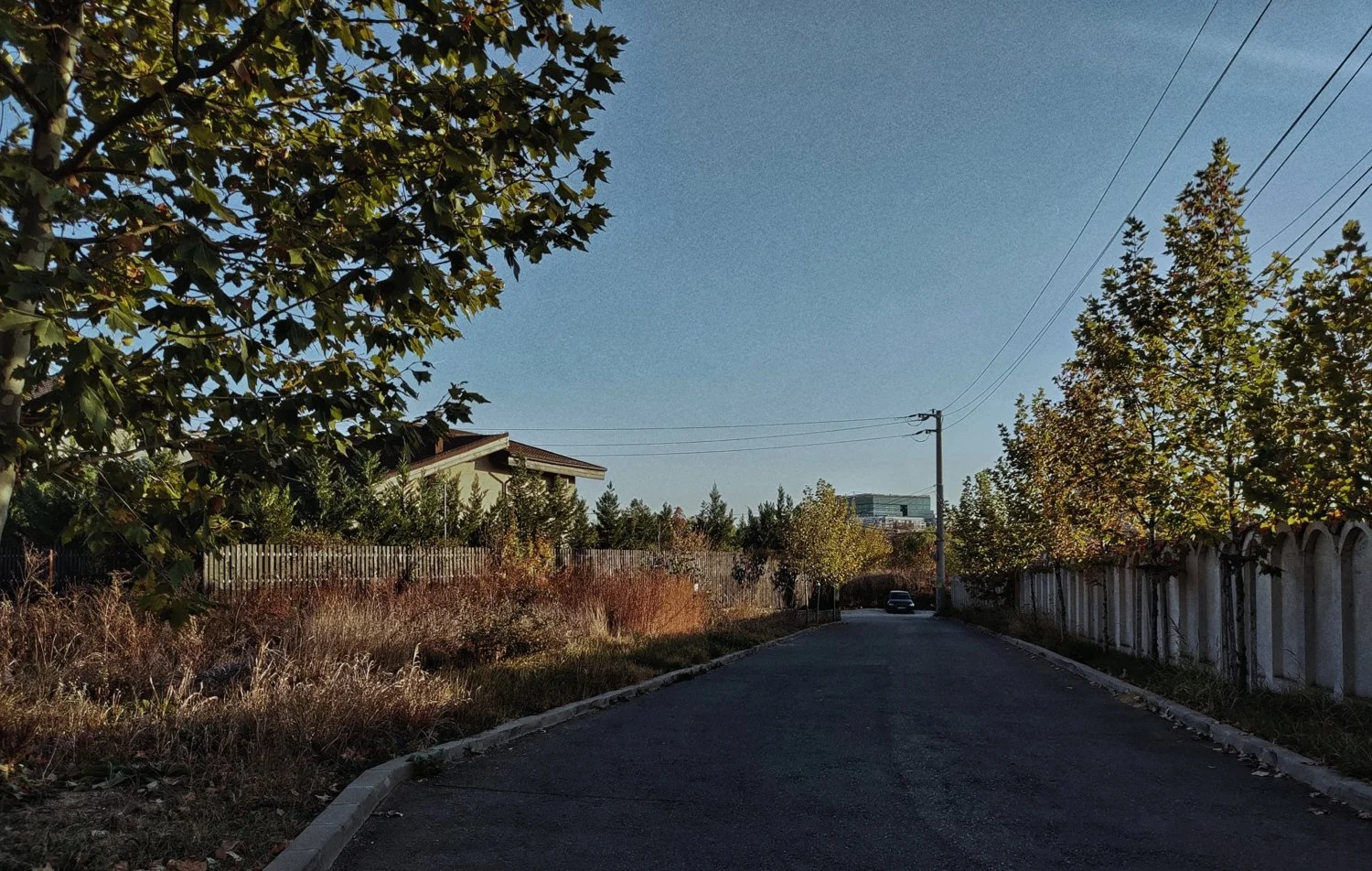
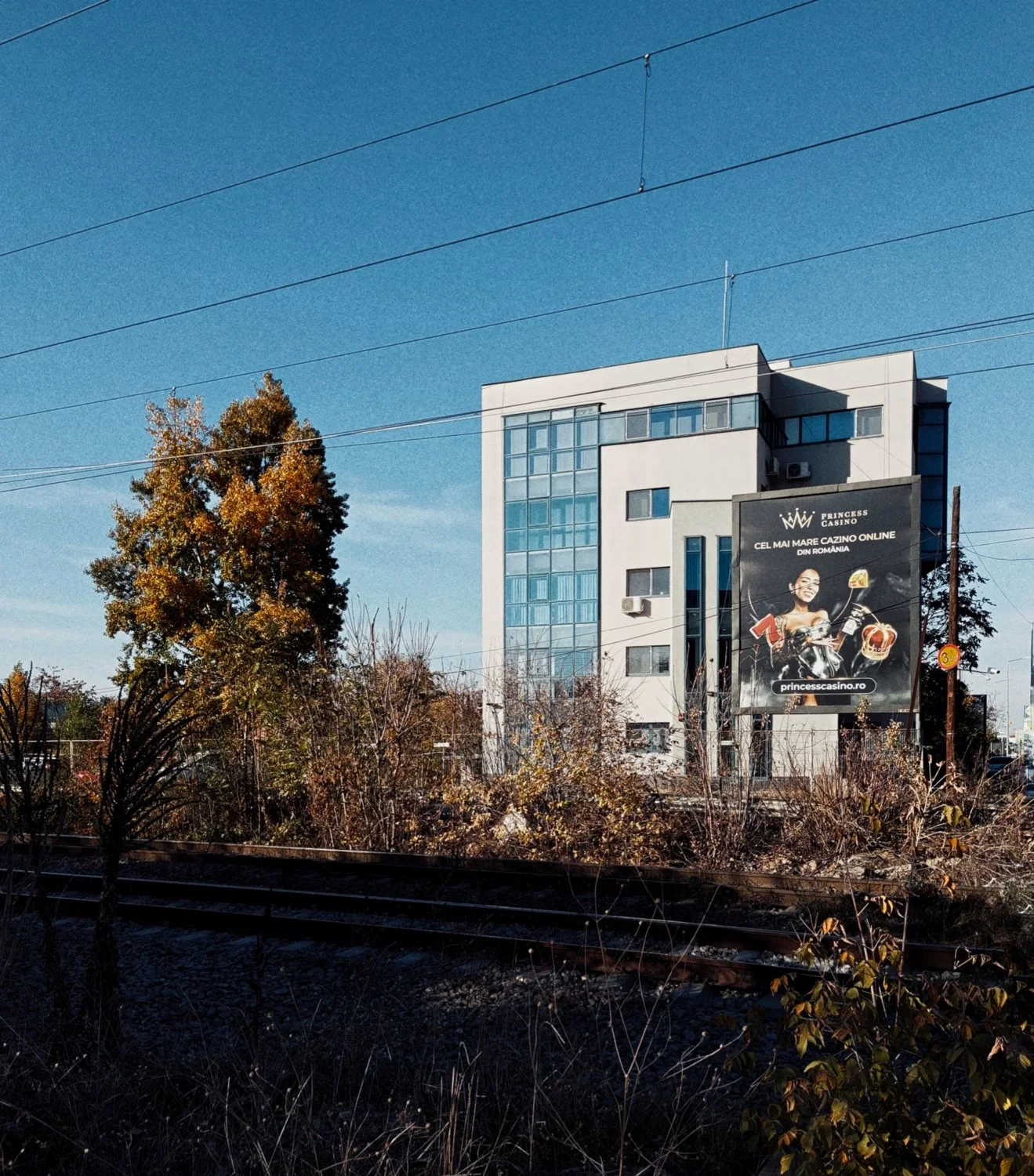
Photos details: Captured in Andrew Tate’s neighborhood (left) Pipera (right) © Alexandra CrisbășanRobert has a BA in Journalism since the earlier 2000’s and has been a political reporter for six years. For the past seven years he’s performed as an anchorman. Being a channel, a medium of communication was always inside him, he says:
“I knew, since I was a child, that I loved words and it comes naturally to ‘speak beautifully’ - these are the two words I hear from time to time. I am humbled by these words, which come from people of various 'universes.' I had no interest in news in my early years, nor in my adolescence. Rather, I enjoyed observing TV male models and how they perform in front of a camera. How they LEAD the conversation was something I probably started to imitate and eventually develop. My job taught me that dealing with information, daily, can offer the illusion that I know a lot. At least a piece of info about everything. The ‘I’m so smart, so elevate’ illusion was something I’ve experienced. Beautiful lies, from one’s perspective. Lies that can feed one’s ego for a while and provide false good mental feelings. Shortly, it became clear this is funny and stupid: knowing everything. If a recipe exists, I hope we’ll find ingredients like constant curiosity and honesty. The art of interviewing is something I’d rather choose to explore as well.”
I absolutely loved his remark when asked what he thinks about Andrew Tate’s ban and what does that say about free speech:
“Umberto Eco upon receiving the title of ‘Doctor Honoris Causa’, awarded by the University of Turin, said: ‘Social networks give the right to speak to legions of imbeciles who used to talk only at the bar after a glass of wine, without harming the community.’”
And about Romania, his response was:
“Romania is unique because foreigners declare that they have a ‘foggy knowledge’ about this country before visiting it and a revelation after discovering a little of our history and some of our natural beauties. I dream of living with my family in a warmer part of this planet, maybe a little to the south of Europe, in the last 30 to 40 years of my life. I love the sand, the waves and the sun 365 days per year.”
I’ve presented you some perspectives from people who live here, while elaborating about Andrew Tate and the controversy. There are more pieces of the puzzle that compose Romania. It’s impossible to cover all of these things, you’d have to visit. So, perhaps, they can serve at least as a 'greeting' to the world.
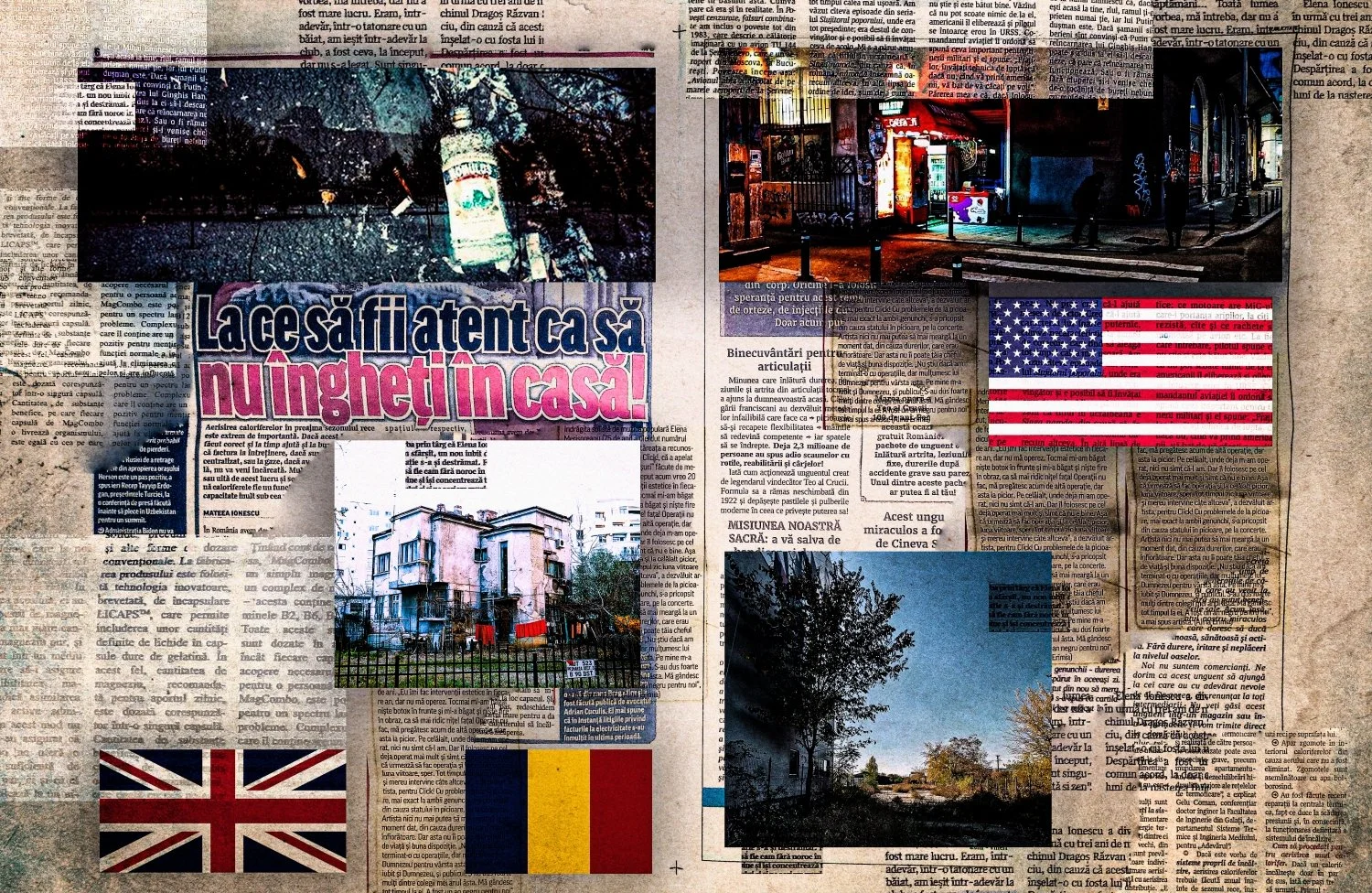
Cover details: Romanian Newspapers I bought and digitally tore up to combine. The images, 1 Izvor Park where I found that bottle, 2. Near Blv. Regina Elisabeta, 4. House in Timpuri Noi Neighborhood, 5. Pipera © Alexandra Crisbășan, flags from wikipedia
Romania compared to
the United Kingdom and United States
Maybe the contrast of having fast internet with very little piracy sanctions while lacking a proper infrastructure for anything, created a rough place to be, which, today, through some of the gaps in the system, helps us remain freer. I’ve wanted my whole life to escape Romania and I despise any kind of system so much that I’ve tattooed on my arm “fuck the system”. I’m surprised to be discovering that Romania’s savagery is partly keeping us from the peak of this collective mess, because we’re already busy with our own and are now watching how chaos is leaking out in every system for different reasons. We didn’t know what to do with the pseudo-freedom we were handed after Communism, but we did dare. We dared mindlessly, without discipline. We have to learn how to use our creativity with less collateral.
Compared to UK and USA, Romania is tougher to live in (at least before the Pandemic) even if we're not far from them when it comes to life satisfaction. There are some contrasting benefits which may be able to "save” Romania, but when it comes to corruption, it overall ranks higher than the USA and UK.
“Romania is facing a worrying phenomenon, shows an analysis based on information provided by the European Commission (Eurostat), the National Institute of Statistics, as well as data extracted from the sociological research Romanian Youth Barometer 2022: More than 60% of young Romanians believe that Romania is going in the wrong direction and do not trust the Parliament, the Government and the Presidency. The number of young people who permanently leave Romania has doubled in the last 10 years, the document shows, compiled by Alexandru Manda, with the support of IRES and the Romanian Academic Society.” Said Robert.
Bribes are a key point in the corruption sector. Romania’s percentage of people who bribe is bigger than the USA and UK combined and we tend to take less accountability as well.
On average, Romanians don’t get to finish 12 years of school, while UK and USA get at least there. Romania’s dropout of school rate is highest among all 3 countries, even though all of them have issues with this.
Adrian sums up well the differences in opportunities:
“The opportunities for the young generation in Romania are immense. Succeeding is a different story. Disparities between social classes, between urban and rural regions, divide Romania in two. Part of it has access to European standards and part of it struggles to survive. It’s hard to do anything when you barely have food on the table or running water.”
In my documenting, I’ve found “odd” balances which in appearance make all three places somewhat close in numbers. Practice reveals how influential differences can be when experiencing. For example, the schooling system is more expensive in America and student debt has a strong grip on young people. The education system in Romania is cheaper, but severely impacted by poverty and corruption. The conditions in which many children are educated lack even the minimum (like having a bathroom inside your school).
Compared to USA and UK, Romania has the least people online and the most smartphone connections. Our broadband speed is best, our mobile one, lowest (I’d add here that we have contrasts in internet quality based on region. Naturally the rural areas suffer). The percentages of people on social media are similar for all three candidates and they all raise when looking at how many young people on socials.
Continuing with the online medium, both USA and UK have taken some actions when it comes to piracy. Romania is kind of in the grey zone here. Nobody cares too much about the content you use or how, as long as it doesn’t seem super shady or attracts attention.
Poverty, neglect, lack of education and a lack of sufficient infrastructure while the internet is cheap and good enhances its use as a form of escapism which can have further impact on mental health, especially among young people who are facing hardships. Still, young people in all three countries are affected by the negative effects of social media.
“My Romania is the one described by Alexandra Furnea, who survived from the tragedy in Colectiv: ‘At the moment, the only weapons we have at our disposal as citizens of this country are involvement in civil society, volunteering, donations we can make to NGOs dealing with Romania's problems, and voting. Voting especially is the main thing we can do to help this country move forward, and the civil society that has turned into a kind of substitute for the state in Romania. It deserves all our involvement and all the help we can offer.” – said Robert.
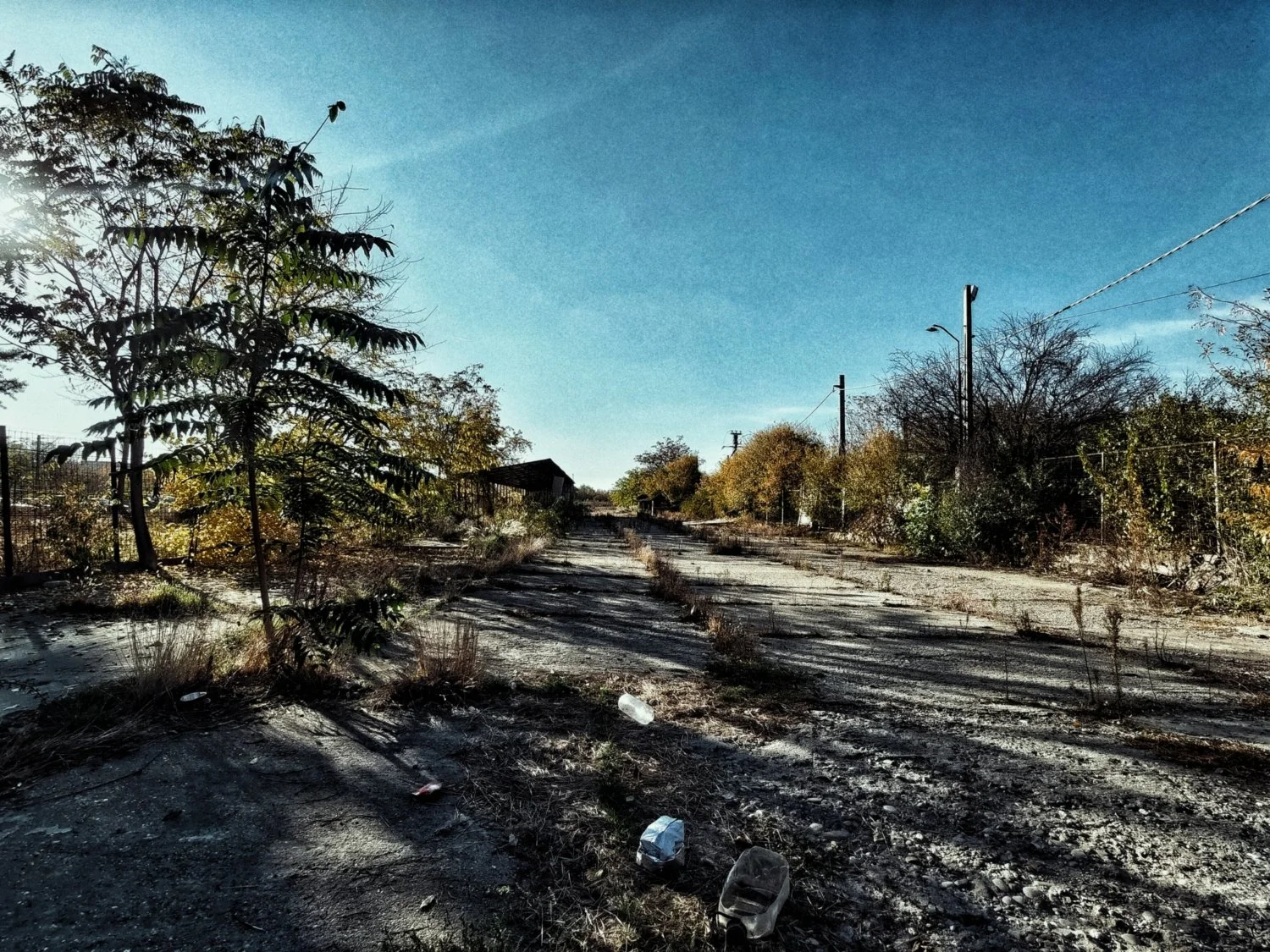
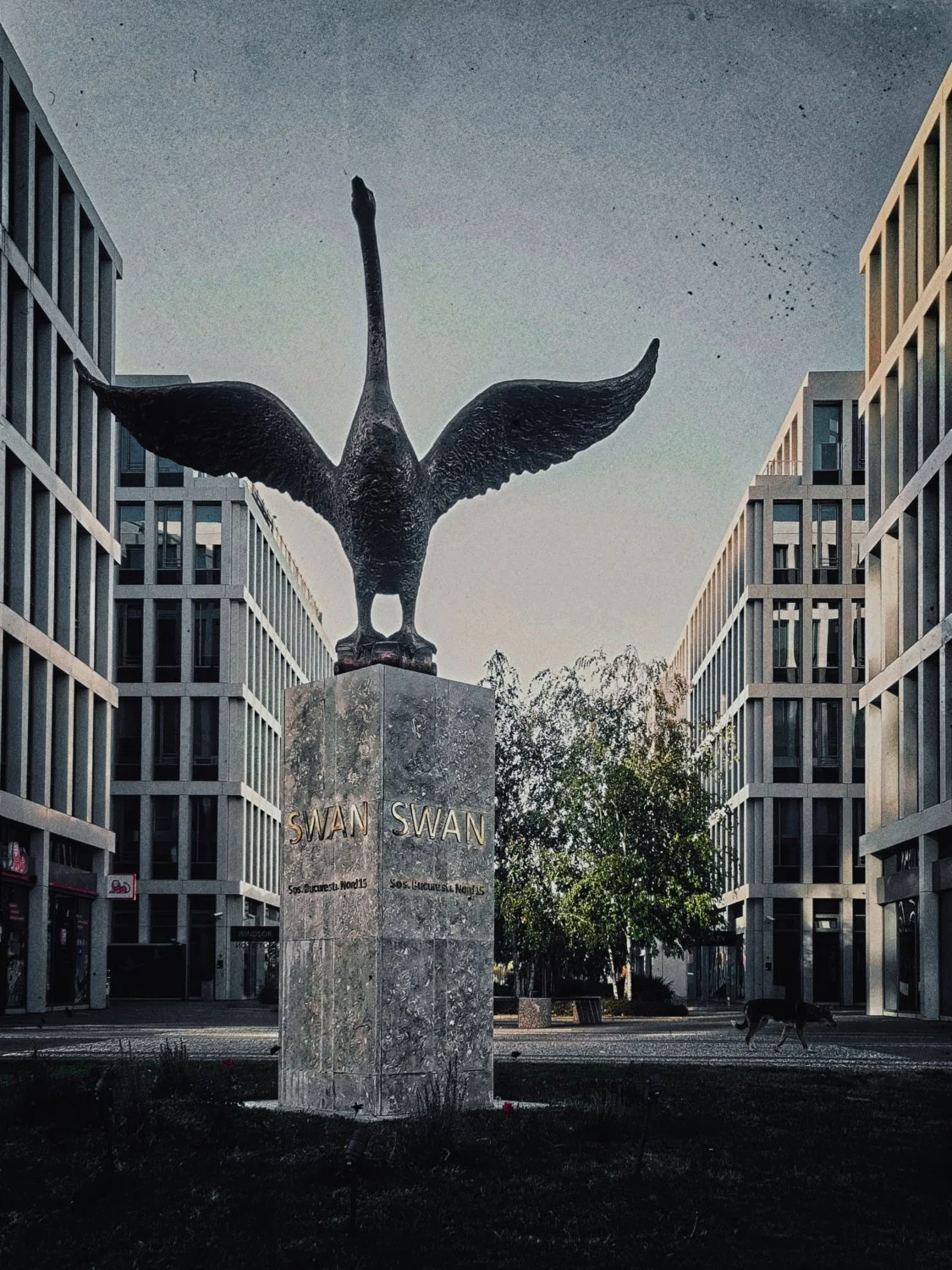
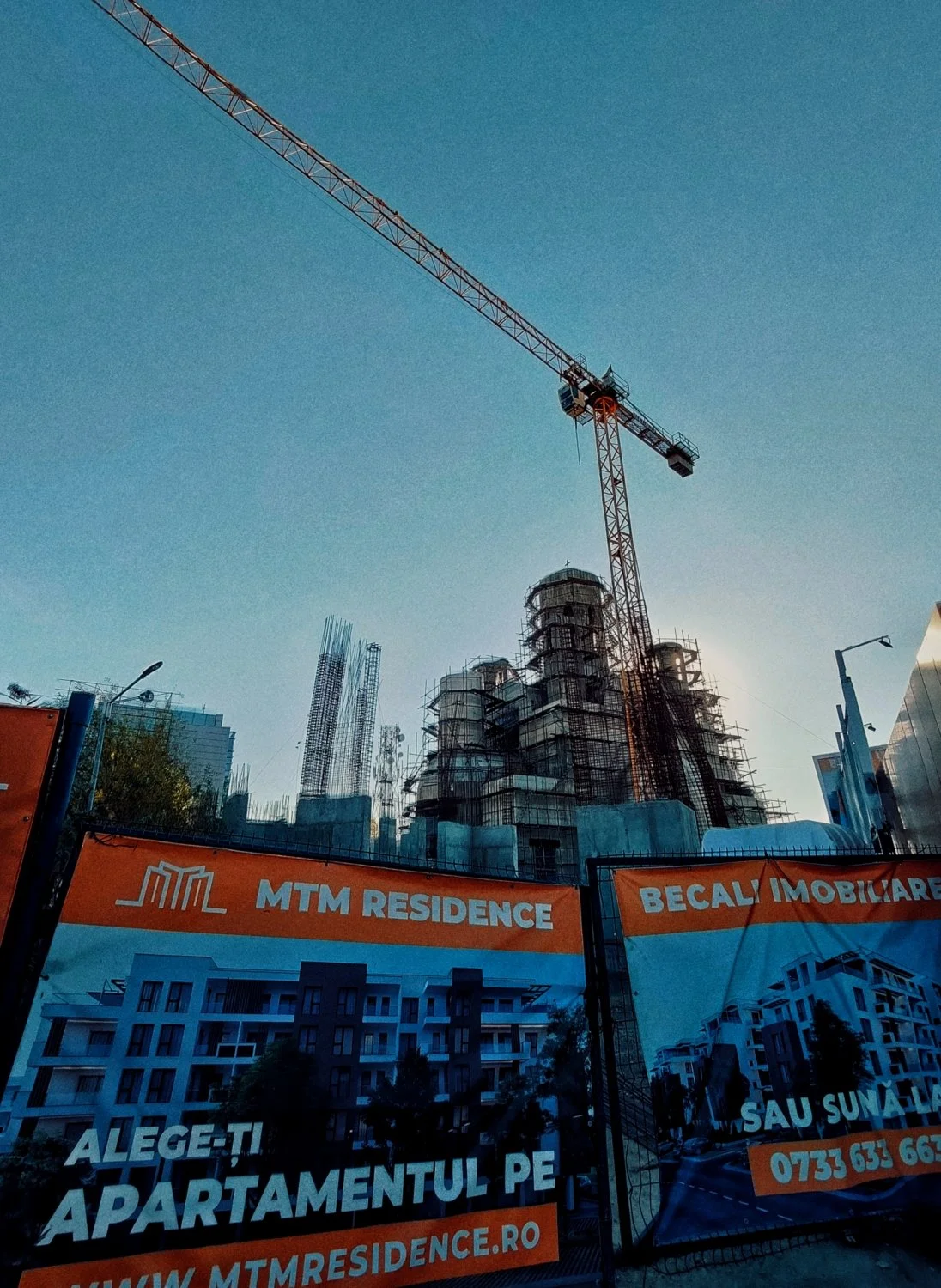
Photos details: Captured on the way to Andrew Tate’s neighborhood, all three Photos are from Pipera © Alexandra CrisbășanLet me give you more context. The UK and USA had a peak of people living at the International Poverty line of around 1% between 1960 and 2017. Romania before the pandemic was at around 2% and its highest peaks were of almost 9% in 1994 and 7% in 2014. *Note that the Pandemic, War and Brexit might have impacted these figures, but I couldn't find the information I needed for all three during and after the Pandemic.
The differences between life expediencies in all three regions are not drastic. US and Romanian women tend to marry at around the same age, maybe because the religious component is also stronger within these two societies. More than 80% of Romanians think religion is important. More than 65% for USA and less than 30% for UK. For all three the main religion is Christianity. I think the more importance religion has; the more gender inequality grows. In Romania only almost 10% don’t have a religion, versus almost 20% in USA and more than 60% in UK.
Women in Romania have less economic opportunities and face more gender inequality than USA and UK, even if the reporting of abuse is similar between all regions.
Somehow Romania has one of the smallest gender wage gaps. While UK has more than double Romania’s gap and USA has a wider gap than UK. In all countries women can do the same job as men.
When speaking of mental and development disorders all three countries are under 20% with USA being on the graver end, Romania on the lighter side and UK somewhere in the middle. However, there’s a stigma in Romania on mental illness and coupled with corruption, makes me skeptical of some data.
When it comes to drug use, USA scores highest. UK has a rate of more than double compared to Romania. Romania is only slightly above the global median for drug addiction.
Maybe a hint on unreported cases can be seen from how aggressive kids are in schools compared to USA (when excluding school shootings) and UK. Children are more violent and aggressive in Romania. The reports for bullying in US and UK go slightly over the 25% mark, while in Romania they are over 40% (I can personally confirm to have had to deal with this, along with many people I know). For physical fights in school, Romania's percentage remains unchanged, while US and UK's pass the 30% mark.
On the healthcare index Romania scores lowest of all three, with a noticeable difference. It might be cheaper to get treated here, but alike the education system, everything else is worse. The best example for how poor the conditions are in hospitals & not only, was the tragedy in Colectiv. Another example, one that’s closer to the subject of this article, one that we’re living with every day is the big number of underage mothers:
“77% of Romanians agree that sanitary and sexual education should be taught in schools, appropriate for each age and as an independent subject, shows the Society for Contraceptive and Sexual Education (SECS). Romania ranks first in the EU in births to underage mothers, with a percentage of almost 30%, and 44.44% of the girls who became mothers at the age of 15 are Romanian, according to the latest data published by Eurostat. Sex education for minors can reduce at least some of the unwanted births of high school girls.” said Robert.
“The relationship between sexuality and education is clearly a directly proportional one. Worldwide, society’s structure evolved in a clear relation with wealth and education. Woman emancipation and the tendency to diminish gender roles differences were fundamental to this change. Sexuality is still a taboo subject among a majority of the older generations of Romania. Regarding underage mothers, poverty and lack of access to education are the main culprits of the phenomenon. Poor families with little education produce children condemned to the same faith. The state has no effective social protection policies in place to take care of children in poverty and it doesn’t seem that any change is in sight. “ Said Adrian.
I couldn’t find proper data for all three, on child domestic abuse (without trafficking). But there’s a saying in Romania which means that: “Beatings are ripped from Heaven” (,,Bătaia e ruptă din Rai”). I'm sure it can be so for both USA and UK, but I don't have the experience of living in either.
The crime rate index puts USA and UK above 45% while Romania has a score of almost 30%. Somewhat it makes sense? Maybe it’s worse since the Pandemic but generally, even if my country is more corrupt, it is safer to live here. It’s a paradox. Maybe, you can say that some corruption takes care of some crime (and guns are not legal), which is a dystopian answer and a solution that makes sense. If regular people have to deal with crime the chances of damage and collateral victims increases. If corrupt people “who know the game” can deal enough with crime and we add the work of authorities on top, maybe we get a recipe that spares more civilians. Which one is better, if you want to think of it in that way, is up to you to decide. There is also a flip side, if the authorities are more corrupt there’s a higher chance of them working with outlaws and that’s a rule everywhere.
All three regions have a serious problem with child trafficking for all imaginable reasons (each with its own particularities). One key difference lays in the fact that within the Trafficking Victims Protection act USA and UK are in Tier 1, while Romania has both types of Tier 2. Therefore, Romania is less prepared to deal with this issue. Moreover, poverty, less opportunities and unstable family life make women get into sex work or are more vulnerable to trafficking (the lover boy method is popular here, there was even a Romanian movie made about it with the same name). As far as how legal sex work is, the most drastic attitude is taken by USA, where it is legal only in Nevada. In Romania it is in more of a grey zone, especially since 2014, just as it is in many parts of Europe. All these little pieces connecting together contributed to Romania’s booming video chat industry. It pays and can be less dangerous and sexual.
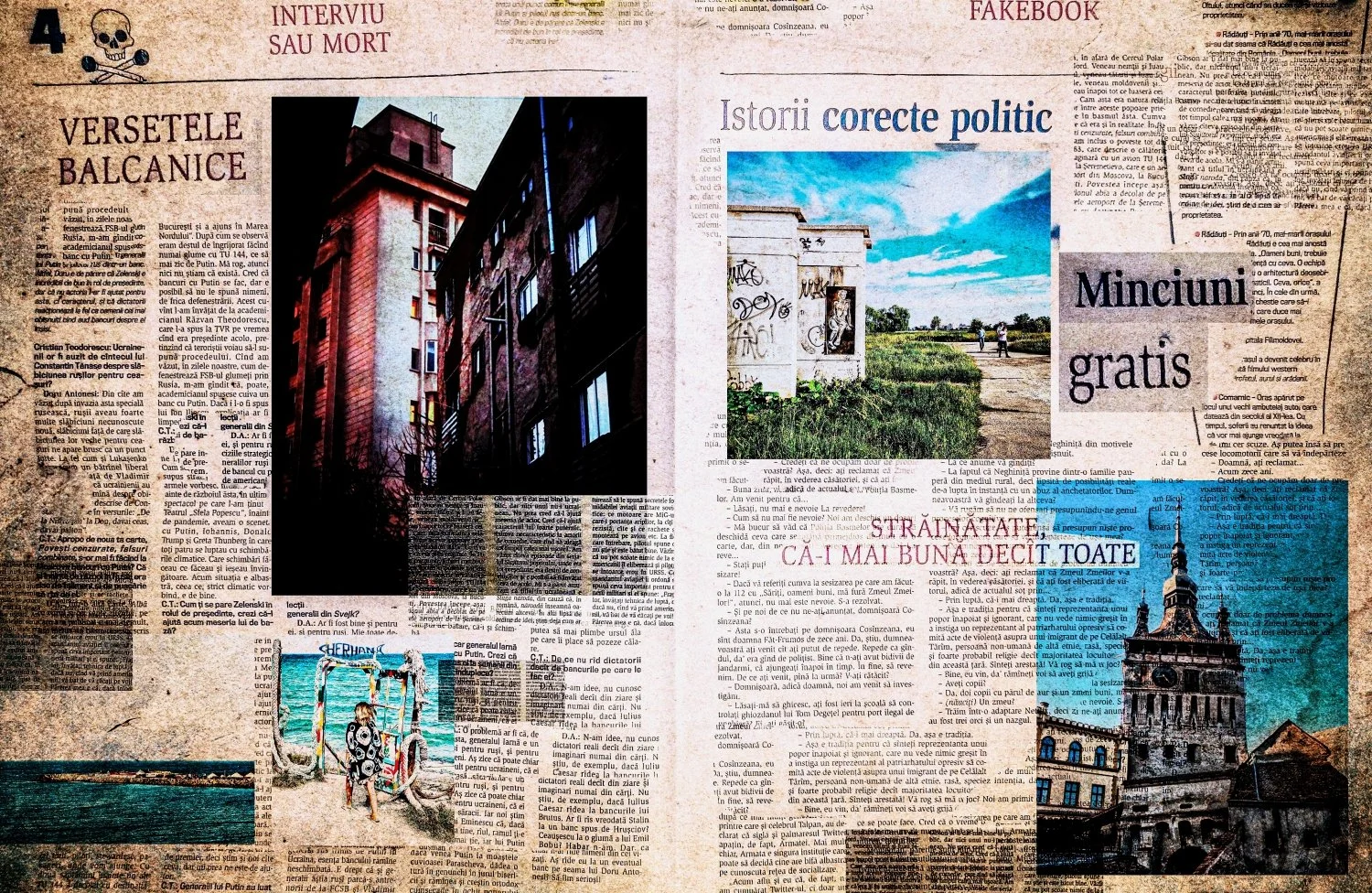
Cover details: Romanian Newspapers I bought and digitally tore up to combine. The images 1. Around Piața Națiunile Unite, Bucharest, 2. Lacul Morii Bucharest, 3&4 Vama Veche, Romania, 5 Sighișoara, Romania © Alexandra Crisbășan
Is the horizon that grey?
As our creations chip away at our freedom, whatever 'tantrums' we throw today are coming from "the body keeping the score". The collective body, of the world. Those who are directed to extremes, either utopian or dystopian can’t yet, dispose of their anger and frustration in any other way. Romania is not my favorite place, but in a few years, it might be one of the few countries where people can truly be themselves without much fear. It seems to me that we’ve gotten drunk on the fact that people are good or should be good. People should be what they are. It’s the only thing that can help evolution, but not everybody should have the privilege to decide who becomes a hero or a villain.
There are positive aspects to Romania, too. We have an interesting old and contemporary culture! Housing is more affordable than other EU countries and USA. There’s been progress made in education, as the Pandemic forced children be able to attend classes online and the structure of the school year has recently changed. The road to awesome locations is a pain, but we have plenty of natural and historical beauties, which can be fun and inspiring. We have a good sense of humor (I’d suggest you to search a few Romanian Stand Up Comedians) & we always find ways to enjoy the next day.
If you understand that not all that is right emerged from a good seed, then Romania might be the place for you. Andrew Tate understood this and it has yet to be seen if we actually understand Andrew Tate.
Romania represents how bold the seed pickers were compared to their ability to handle what the seed demanded. Andrew Tate could be an example that teaches us to be wiser. There is a danger to his influence, but I don’t think it’s the most toxic example Romanian young boys and girls get. I think we should stop blaming the influence media has, as long as we, cannot educate our kids well enough to not take seriously what comes through their screens and the media should change that dictatorial perfume.
Andrew Tate is one of humanity’s representatives which we have collectively decided to show off to the world. If you don’t like what this reflection exposes, get a better world. Help in making one. Learn how to filter information, so you can start accessing more qualitative one. Think for yourself. There is no radicalization going on, it already happened. Being offended more by Andrew Tate than by other terrible things on the internet tells how much work we still have to do.
I’m curious of what his journey will be, if it will degenerate or positively change. This is a window to the world where I come from, a world much larger than me, where now Andrew Tate got closer to the frame. Through it I see that freedom is being replaced with a cheap copy while others make billions. We forget to live and to truly contribute in making home, a better place. We should focus on equity. To keep using duct tape because we’re too comfortable to go to a mechanic or learn to fix thoroughly will not work forever.
I believe the Pandemic and this war have forced many countries to begin a transitional phase, making everybody vulnerable. I’m curious to witness the upcoming unfolding. In a way, I have more hope than before. Even if, unfortunately, fear is still a powerful force, it can also motivate us to strive for stability in these trying times. Until we’ll be ready to grasp different realities without the means for a conversion to something, but through the means of human curiosity for more knowledge, I won’t be able to trust anything. I’ll keep developing my way of thinking while thanking both society and Andrew Tate for reminding me how vital it is. With the risks it might bring, if I keep thinking maybe I have a chance to inspire people to question more instead of comment or at least, to comment after questioning.